AD 2025

[Notes from my Little Letter Republic]

Whenever I feel plucked out of time, or stumble into a trough of aimlessness, or when philosophical questions addle the mind, I shake myself out of such lethargy by taking to one of the oceans of intellectual inquiry which in themselves are enjoyable and lend little prospect for my own career advancement: languages and mathematics.

This January was no different. Like the Finnish tradition of forswearing alcohol for the month of January, I put down the bottle and picked up a different intoxicant: Biblical Hebrew. Endeavoring to learn Genesis 1 and some few prayers, I managed to become significantly more comfortable with the “alephbet” and to build a bit of vocabulary before the old desire for practical advancement and struggle came back to alleviate my self-imposed relaxation. Similarly, I made several advancements in my deployment of integral calculus and spherical trigonometry.

And thus, after plucking the first fruits from the tree of knowledge, I stole away from the garden and went back to researching and writing essays. One on Milton-based humanities curriculum (John Milton) and another on reforming the aesthetics of the St. Louis Science Center.

This year was the biggest work change in 5 years, as I was finally able to reduce my workload from 3 full time jobs to 1.5. Over the past 6 months I have offloaded 96% of my administrative duties on one campus and dropped teaching two courses. So now I am only executive director of one campus and a teacher for three courses.

I spend a lot time staring at financial models, which I enjoy, talking to students and colleagues, which I enjoy, and running the gauntlet of open houses, follow ups, enrollments, check-ins, re-enrollments, update emails, hiring, follow ups, and subbing.

Now teaching at a a classical, catholic, hybrid school is one of the best places one can be. It is intellectually stimulating, the colleagues are intelligent and dedicated, the students are interested and engaged, the vibe is low-tech and bookish. I am raising my kids in a community of other parents who are also raising larger families, and so we have a deep solidarity.

Because of my reduced workload on the two home days I spend 5 hours working and 5 hours with the kids while being the executive function for my son in his home day work for kindergarten. That home day work takes about 45 minutes — usually spread out over an 1.5 hrs.

I am slowly figuring out how to work the finances of the school better so that we can compensate our full day people: if we found the donor who could make that happen, we’d easily be the best educational institution to work at in St. Louis. We’re already extremely close. My philosophy is “hiring is policy” and “quality of life is half compensation.” Or as I sometimes say; it’s a phenomenal place to work if you can afford it!

Last semester I taught two Latin courses, Geometry, Chemistry. This semester I have math, Latin, and moral philosophy.

Latin this year has been more fruitful than normal. Teaching the Aeneid in Latin is always a treat. And Vergil’s poetic style, my Lord, there is nothing like it! “Sink their submerged decks!” or “Disiectam Aeneae, toto videt aequore classem,” which can’t really be translated justly.

And this year I read more of the Roman historian Sallust in Latin, whose opening to Bellum Catilinae stirs up moral and intellectual ambition in the soul. But Leibniz’s Latin mathematical writings were especially fun and clear. It felt especially clarifying to be explained quadratures in Latin.

And just as sweet, since I have a colleague who delights in Latin, we together read Latin poetry together this year.

One of my favorite things about my local friends is that we read and discuss poetry together. I highly recommend finding friends who will do this with you!

I think often about what place I want to build for Latin in educational culture. I rely on the analogy of music. Latin is an instrument unlike other instruments. Why learn to play an instrument, but for the pleasure of being the conduit of the music? There is no way to get the pleasures of Latin without reading Latin, just as there is no way to get the pleasure of musical performance without playing the instrument. And because Latin grants access to particular cultures, if you want the ideas from those cultures to be part of the makeup of your soul, then you will want Latin – for law, for poetry, for hymns, for medieval philosophy and theology, and the early stages of the scientific revolution.

It’s embarrassing to me that my favorite ancient texts are actually almost all in Greek. Plato, Thucydides, Ptolemy, Archimedes, Aristotle… Greek has the best material, superior to Latin. And my Greek is out of practice. Yet by being the language of administration, Latin became the language of Western Europe. There might be a lesson there about the relationship between academic and civic language and culture. Perhaps if general Belisarius had succeeded in conquering Italy…

Antigone Journal has an ongoing contest for contemporary Greek and Latin editions, the prize being a complete Loeb Classical Library. I am excited about this, because there is some prospect for building more intentional living communities of classical learning, despite the falling numbers of departments and programs. The National Latin Exam, for example, continues to decline in number of participants, but the bleeding, I predict, will stop in the next 5 years if not sooner.

And even more exciting is that we will unlock the library of Philodemus using all that AI compute. It really has never been a better time to brush up on your Ancient Greek!

In Moral Philosophy, I finally have each of my lectures thoroughly worked out enough that I can compile my handbook for Applied Virtue Ethics with its tour of Kant, Mill, Aristotle, and Aquinas. What I really want to get across is a theory of justice which takes seriously justice in exchange as the form of justice which undergirds economics and much of daily life, and prudence as a personal art of expected value calculation. With a proper theory of double effect, I can help vastly improve reasoning in several areas, from clinical trials to immigration to national defense and romance. I especially want to challenge Catholic relativism in matters of prudence, which is a widespread issue, and provide a theory of justice that can clearly ground higher quality Catholic social thought.


My reduction in duties has gone well. At my peak pain point I was running a school, dean of high school at a different campus and teaching 8 courses across two campuses. So I know I have a great capacity to run on all cylinders.

And I will take on new projects in the future, but for now I am trying to explore, explore, explore, and resisting the sultry and racy seduction of new commitments, whose lips drip with the honey of deception and whose eyes shine with the meretricious allure of the oxygenless void.

The big events of this year for me have been recruiting one of my friends back into St. Louis to teach with me, hiring a former student of mine and team teaching with him, joining the Center for Educational Progress, visiting Ghana for the Emergent Ventures African and Caribbean conference, and presenting at the Fitzwilliam Seminar on Milton Friedman at the University of Chicago.

I am really proud of my friend Jack for finally launching the Center for Education Progress, which he has been talking about in various forms since at least 2018. So far the organization has an impressive list of allies and has published many excellent essays over at educationprogress.org. I have been able to assist the marvelous team on the policy proposal document providing guidance to certain government agencies, and I hope to keep working on some more projects soon.

I have also enjoyed befriending Anjan Katta and learning from him about the very cool hardware stack currently deployed in the Daylight Computer and possible futures there. I think the tech he has in the pipeline is really phenomenal. I look forward to seeing those iterations and being some contributor to his work’s success.

At EV Arlington, I made several new friends. Fergus let me stay in his room when my flight was cancelled, and Dan and I solved the mystery of the CCP scriptures. I suppose the message I took away from that conference was “Keep building your own society.”


My first time in Africa was for this years Emergent Ventures conference in Accra. These are observations from my green eyes.

It was more difficult to get into Ghana than expected. Getting the yellow fever vaccine required 16.5 phone calls and hunting for regulatory arbitrage. The unsecure visa portal stole my credit card, and when I messed up some paperwork the consulate was unresponsive. Once en route, though, it was easy entry into the country, and I found friends in the DC airport, Sebastian of Panama and Lamin.

My first impression of Accra was a deep inner peace at the high quality queuing at the baggage claim. The British did their work well, I thought to myself. Ghana was extremely safe. Jerry Rawlings, sir, you did in fact set the society on a peaceful path. One could tell by the posture and body language of people that the expectations for social interaction were positive (and I don’t mean interaction with me – a comparatively rich tourist). The general tenor of the streets was of safety.

My second impression of Accra was that the roads are good. We drove down the airport drive and the road was perfect. The minister of defense and some other ministers tragically died a few days prior in a tragic helicopter accident. Our bus driver blamed the cheap government for buying unreliable Chinese helicopters and not servicing them properly. And now as our conversation about culture turned to the finer points of the origins of Accra neighborhoods, the road literally disappeared at a major intersection. What is this? Why is a major intersection missing street? It would take a single day to fix this giant welfare loss. 50 mph driving suddenly slowed to 5 mph and into a great cacophony of chittering beeps as cars, trucks, vans and transports signal, hoot, hand gesture a negotiation through the intersection. It was a kind of beautiful harmony that I grew to love. The beauty of emergent order and communication on total display! But the achievement of infrastructure is to, you know, decrease the chaos, and increase the speed.

This led me to a second observation about the cars themselves. Old, beat up, painted and repainted coups were super common. Seeing people zip along in their cars, I could feel the love of cars throughout city. People love their cars and want to keep them going as long as possible. At the same time I was impressed by the number of new Kias, Hyundais, I even saw a couple Honda Accords. The frugal lower-class altruist and stingy saver within was almost offended: “You took out debt to buy that!” But I thought of the Queen song “I am in Love with my Car,” which basically justifies car culture on its own. Pace, walkability enthusiasts.

The third impression I had of Accra concerned labor. I have never seen intersections lined with people selling snacks and doodads in such numbers – one person was even selling a nail clipper set – nor have I seen such a high number of people doing very similar jobs, taxis everywhere, 5 porters at the hotel door, three clerks at the desk, several pool boys – a very visceral oversupply of labor. Immediately my mind started turning on how to turn the labor force into higher value occupations in as few steps as possible.

My goals in Ghana were to learn to negotiate prices, learn why every African independence leader was a socialist, and discover how to get around in an African context.

A group of us went to the Tetteh Quarshie art market via two Ubers. Unlike in the US where Uber drivers seem to lease richer vehicles than they should, Ghanians seem to be more realistic about what vehicle they will drive in. It took about 30 minutes to get from Labadi to the art market, but the drive was a good look at the city. I saw a perhaps vacant Willis Towers Watson building sporting the 2017 post-merger logo. So maybe it was still in use? The last Google review was from 6 years ago. And there is the possibility the building has nothing to do with the American company.

The roofs of almost all the building in the city were corrugated iron, a material I know little about, but is apparently the go to for shelters of all sizes and costs. The church roof was iron, the shack, the barber, the fancy restaurant, all corrugated iron. Some houses had large rocks sitting on the roofs providing additional weight to the slices of metal perched conspicuously over a leak.

They say the city proper of Accra has 2.8 million people and the region has 5.4 million. But the traffic was none too bad, except at night. Then it was very slow going. The opposite of, say, the 270 belt in St. Louis which is jammed before and after work (Lord, make haste to send congestion pricing!). Why are there major traffic jams at night? It only took me a minute to unravel the mystery. During the day maneuvering around pot holes is easy – at night very difficult. So night traffic is perpetually in molasses. Now while my urbanist friends will talk about the need for bike lanes, public transit, and improved walkability, the real issue is road quality. Throughput. There is plenty of transit available. Vehicle ownership is clearly not necessary to get around in Accra, but if you want to fix congestion and reduce pollution, repair the roads.

When we got to Tetteh Quarshie I was determined to hurl myself into the arts of the market. It was a single covered basilica with shops on either side. Some people were makers but most were resellers. The shops were frequently the size of a dining room, lined with shelves, art, knickknacks, doodads, and a man or woman strongly encouraging you to come in for a look. “Sir, Look! What do you like? Sir, come in!” Some were more insistent than others.

I had some people show me some art so that I could get a sense of what the motifs were, what was common and what was uncommon. I found an old seamstress putting together dresses, and knowing that my daughter was likely bigger than a daughter of the same age in Accra, tried to find a dress that seemed the right size. She insisted that the one I was interested in would fit her, but I wasn’t so sure it would be big enough to grow into, but merely fit for the month. We went back and forth on price as her radio played an English language political commentary on the spiritual dimension of Ghana’s woes. She was mildly disappointed, but we settled. She tempted me to buy something for my wife. But I told her such a venture was too risky.

Sam E. and I found a friendly gregarious shopkeeper and asked her how to negotiate prices. She was a special type, because the normal procedure is you ask how much, and they make a starting bid. It is rude for the buyer to make the starting bid. Nonetheless, this giddy gal was happy for Sam to make the starting bid. And he shook and trembled and exclaimed he had no idea what makes sense to offer. She reassured him, Say what you think, and if I don’t like it I’ll say no. This led into a discussion about the game theory of prices. He’s afraid of overpaying, and he doesn’t know what prices make sense. Then we started talking in hypotheticals, if I were to offer 50 Ceti for this, what would you say? Hypotheticals made it easier for us Western boys to get in the swing of things. Sam made an offer and she immediately accepted, and he told her that that indicates he should have offered lower. She denied it! But he reasserted the veracity of auction theory.

When I returned to the market after a break, my crowd was gone. I went and talked with the shopkeeper at the entrance, and tried to buy some knickknacks for home. I won some respect for having eaten goat fu fu, which indeed was good. We went back and forth on price and meanwhile I pleaded ignorance about the relative values of things. So I got her to discuss expected prices of art (which she didn’t carry), taxis, and so on. Part of that was so that I could budget my limited funds, and part of it was so that she could figure out what price she could offer me for her wooden turtles, and I could start calculating the value of labor. Nonetheless, she was older and more experienced and pulled a couple of slight exaggerations on me in the course of our friendly discussion. For example, she knows what she pays for a taxi, but didn’t want to be fully honest about what price I am going to get offered, which was about 2x that.

She has the best location in the mall, so I asked if she has to pay extra to get such a good spot. She said no, everyone pays the same for their lease. I was visibly shocked. But you have the best spot! I purchased my turtle, and she gave me instructions on where to go to find a taxi. She also said if I wanted the real experience, I would ride in one of the 12 passenger buses that shlep people around and always have a 17 year old boy hanging out the window hooting and hollering. I wanted to do that eventually, but never had the chance to spend 3 hours getting lost in Accra, which is what I would budget for such experiences.

Instead I found a taxi, and that guy dug in on a price that was almost 2x the standard street price. I negotiated him down 15% since I thought it was a 30 minute drive to Labadi, because that’s how long our Uber took. Apparently our Uber was as incompetent, as the taxi said they are, because it was only ten minutes back to Labadi.

Why do all African independence leaders believe in collectivized industry and state run enterprises and import and export tariffs and all these other terrible economic policies? The answer I was given over and over again at the conference was that Anglo economics and Anglo politics were not considered separable. If you are rebelling against colonialism, by necessity you are rebelling against capitalism, there was no other way to see it. This really bothered me. How is that possible? A 1:1 correlation?

The deeper explanation which I am significantly more satisfied with is that price theory and what today I would consider standard supply and demand economic analysis was also not readily available. Although Hayek existed, the Chicago school was still young, the Solow Model and Schumpeterian growth were undertheorized and not yet ubiquitous insights (of course, even today one of our Nobel Prize winners is far more confident in strong industrial policy, “rethinking capitalism”, that Urho Kekkonen’s education reforms have a lesson for the US, and that big firms should have to share their data than I would be). Good arguments for bog standard capitalism were just thin on the ground through most of the 20th century, and the fact that it works was less a testament to its intellectual foundations than to the practical outworkings of common law and democracy plus property rights.

Towards the end of the trip, a small group of us went, of course, to Eric’s coffin shop! It was a short walk on foot down the beach. Eric makes the amazing fantasy coffins. You can be buried in a fast fish, dear reader as Herman Melville would wish it, or a loose fish, should you desire. Or a chicken in memoriam of your mother’s broth. Whether airliner or Nike shoe, Eric has the coffin for you. They are simple pine boxes and competitively priced. The shop was merely a shed with chain link. No proper display, too few commemorative items for sale. The parking was not good and the signage was nondescript. Eric is a simple, humble guy. He’s done expos in Paris, been featured in the Guardian, yet even some small adjustments could increase his profits. It would make sense to expand the business if he were interested.

I think Ghana is like this generally. Some small expenditures of 10k to 100k, and the long-run rate of return would be quite good, not to mention the value of increased economic activity and moving up the value chain. Of course, the forces of corruption are hard to contend with. But where there’s a will… there’s at least a cleaner beach.

Ghana was my first contact with hunger. Although, it was a very pleasant place, it was also evident that some people were smaller than they otherwise would be because of malnutrition. And only after I left did I realize that the doodad sellers, the women balancing bowls of bottles and snacks on their heads, including that guy late at night selling some purple ichor out of a plastic bottle, were in fact beggars in an equilibrium. Hence when one of our taxi drivers bought a bottle of water, it was semi-charitable purchase of convenience.

And that particular taxi driver had the best coup car. Racing red with a green racing stripe, a faux animal pelt carpet on his dashboard, a necklace and several charging cables drooping vinelike from his rearview mirror, a giant crack across the windshield, and racing car seat covers in green and red. He had the stuff of funk.

The Conference itself was wonderful. The organizers did a good job mixing freedom and control as the non-Africans can be trusted no more than Marcus Brody to not get lost. If you wanted to explore on your own you could, but at no point did you need to.

We visited Christiansborg Castle (isn’t that redundant?) and there the office of two-time coup leader, Jerry Rawlings. Sadly the castle is in disrepair, and the tourism board seems to not care about or take any professional pride in it. Another missed opportunity.

The tomb of Nkrumah, which is truly a stunningly beautiful monument to the independence leader would fill me with patriotism, if I were a Nkrumah fan. We had a conversation about if you could give Nkrumah advice what would it be? One answer: wait 20 years. Independence isn’t as good as you think it will be.

The conference sessions were quite good. Finally got to meet my friend Luke Olayemi in person. He ran one session on developing new concepts for describing internet social life, which I thought was very fun. And I want to see more ideas from him.

We had a session on U.S. – Africa relations. In the wake of major US aid cuts, emotions were complicated by the feeling of great frustration with African governments. If it were solely a matter of the U.S. refusing aid, that would be one thing, but the incompetence of the government means they lack the capacity to react usefully to a shortfall in medical aid. And so there was spirited disagreement about how to think about the US – Africa relationship, and what to hope for.

I met a nuclear medicine doctor from Botswana who is opening up a clinic. He can confirm there are more cows than people in Botswana; he owns 3. I noticed the pan-African comraderie was quite strong. People talked about other African countries the way we talk about other US states. This made me quite optimistic for future economic and political unions arising. I asked some of the ladies which country has the best men for romance and marriage. The answer: for romance Nigeria, but for marriage Uganda. A Nigerian later responded that female view is because Nigerian women have trained Nigerian men in the art of excessive and conspicuous expenditure on their girlfriends.

Jan Grzymski, leader of 89School, a program on Poland’s post-soviet liberalization showed off his political science board game How to Win Brexit. We did a mini-session, where Rebecca Lowe and Rasheed Griffith blasted me (Donald Tusk) into the smallest of smithereens with their much more serious and deep knowledge of the EU.

I recruited Sam Enright at noon to help me measure the sunlight so that I could calculate the relative latitude of St. Louis and Accra myself. I was off by a couple of degrees, but the measurements were done two weeks apart. It wasn’t bad for some slapdash measurements.

I enjoyed talking to Samukai about Liberian census tracts, David Perell about art, Rebecca Lowe about philosophy and novels, and several of the younger crowd who are working on academic competition prep in Kenya, Nigeria, and a few other places. Joshua Walcott and I went several rounds on religion and morality. Duncan Mcclements and I went many rounds on economic development and FDI. Lorenzo talked about building the tourism industry in Belize, Lamin on building an ambulance network in Gambia.

Andy Matuschak and I enjoyed a lively dinner conversation about Great Books and 20th century learning and possibility of diminishing returns.

Rasheed nudged me to work on Spanish more and get involved in politics. Advice I have taken.

Every EV conference has a takeaway line. This conference I felt the message was “good governance is hard to find.”

Retrospectively, I wish I had offered a session on what Classics has to offer Africa, building off the experience of Malawi, and discussing the origins of good governance in the classical world and soliciting for African examples.

I would like to tarry and indulge in divulging every insight and experience in Ghana, because to write about one’s travels is to travel twice.


In October, Sam Enright pulled off a great coup at the University of Chicago with his conference on Milton Friedman. We met at the Quadrangle Club around a large polished wood table, in a secluded academic board room, served fresh water by the pitcher. The type of place where one could plan all sorts of thing… but not secure enough to plan too much global disruption: it’s not enough in plain sight!

Since it was my first visit to the beautiful University of Chicago, I was able to take time to wander early in the morning. I drove into the city from the west and as the sun rose over downtown I listened to Tyler Cowen’s tour of choral music with Rick Rubin. That was such treat, Monteverdi and Shaw as the sun rose up behind the shoulders of the iconic Willis Tower.

When I got to campus parking was easy and the journey was light.

We started with a group in coffee shop and immediately got into full geek mode.

Kadambari Shah started off the conference with a session on Milton Friedman in India, which was great for its parallels to Milton in Chile.

Agnes Callard and Rebecca Lowe brought philosophical heat and burned away some of Milton’s superficial philosophizing. Rebecca impaled Milton’s distinction between political and economic systems when discussing capitalism and socialism, while Agnes scattered three handfuls of dust on Milton’s logical consistency in “The Moral Obligation of Business is to Maximize Profit”. Both certainly depressed any claim Milton could make to being a logically consistent philosopher.

Robin Hanson presented on Milton Friedman on mechanism design, and mostly focused on explaining the deeply limited case for government intervention in alleged market failures. This discussion was also helped along by some quick insight from the extremely sharp Anup Malani.

(Anup by the way once again excoriated my argument that hybrid education provides economic savings. This got us into the timely argument about Baumol and whether education services can actually experience new efficiencies. Then, when I made an argumentative gaffe concerning total cost, he pounced like a tiger, lithe and deadly, and ended my argument. It was a glorious massacre. I gathered up my entrails a day later and reformulated into something he could accept.)

Sam E. was saddled with Milton Friedman on Monetary Theory. Despite the monumental task, a task he shook from his remit in vain, Sam did a great job, and started with a statement that very much compelled my interest. He said that he loves the way Milton’s Monetary History of the United States is written. That it is a good causal history, and he wondered why there are not more like it.

I have a whole list of books that fit my preferred style of historical writing which I will be sending him shortly.

We had good lunch conversation over the standard questions of global monoculture and cultural churn. I am more optimistic than many others, but probably because I spend most of my time in a small community that is intellectually stimulating and has a high birth rate. I don’t feel the stultifying effects of the academic landscape that my peers who teach do.

My own presentation on the economic history of Chile went very well despite the late hour and the growing exhaustion of the participants.


The best podcasts this year were:

Statecraft by Santi Ruiz. Santi Ruiz interviews excellent researchers and practitioners of everyday governance. Great background if you want get involved in civics at any level.

Marginal Revolution Podcast – Tyler and Alex getting back to just talking economics. I really like it.

Dwarkesh Podcast – Sarah Paine lectures on Russia and China from the Naval War College.

Best films I watched this year were:

A Touch of Sin (2013) Chinese film about sin that is a series of vignettes. Some of which pretty were tough to watch. Seriously good film though.

Paths of Glory (1957) Stanley Kubrick film on a WWI court martial. Riveting meditation on the hell of war and the injustice of scapegoating.

Live Die Repeat (2014) Tom Cruise. A riveting and interesting action film.

Through the Olive Trees (1994) Kiarostami. Finally finished the Koker Trilogy. It was a really lovely film, and I am such a sucker for this type of Umerto-Eco elegant conceit of nested realities. Kiarostami is like a Renaissance courante between realism and a protagonist’s incredible persistence for love.

But the best cinema experience was renting out a theater and having a bunch of my friends and the St. John Paul II crowd watch the French film Of God’s and Men (2010). That indeed was a great experience. We had about 50 attendees. Thank you Robby for collaborating on this and taking care of technical aspects.


I taught Chad Kim’s new book Primer on Ecclesiastical Latin to my Latin students this year. It is the best in the genre of ecclesiastical Latin textbooks. The layout of the book is straightforward and made to pair well with students who have taken or are going through Lingua Latina (this does not apply to my students), but I appreciate the grammatical lineup.

Good introductory Latin textbooks provide limited and essential vocabulary that prepares students for reading particular authentic texts. When it comes to preparing students for ecclesiastical and medieval readings, especially scripture and St. Augustine, this book is head and shoulders the best in the business. It is also complete enough to be useful for self-study.

In books, I thought it was a thin year for me. I read a lot, but not a ton that really rocked.

Middlemarch by George Eliot – if you know, you know. I started it before the Middlemarch craze seized the world and finished after the wave had passed: worthy though it is of eternal hype.

I read a lot of Leibniz in 2025. Maria Rosa Antognozza’s biography is the secondary source to read. Maria sadly passed away before I got to talk to her. There are a million did-you-knows one could offer about Leibniz, but a recent one was that he wrote three papers on mortality tables and life insurance. And naturally the reason the royal we are interested in Leibniz is because of the style of intellectual life he lived – both at the cutting of philosophy, mathematics, and natural philosophy and steeped in the Aristotelian and Lutheran traditions – both concerned with finding new angles on traditional intellectual problems and determined to break out into new fields – a role model for what verve looks like.

And in academic writing, I found great interest in Edna Ullman-Margalit and Richard Posner (the Pos!) and various other law and economics writing.


Music was a tragic year. My favorite radio station 88.1 KDHX after two years of internal dissensions and infighting gave up the ghost. The station was my number one way of being exposed to new music in folk, alt-rock, “world music”, and really any genre except classical. The loss has caused me to be more intentional. I have been prowling archive.org for old KDHX playlists. I have turned up two awesome albums from 2020.

Music of the Sani by Manhu. Rural Yi music from southern China. Super delightful. Only a handful of views on YouTube.

Kompromat by I LIKE TRAINS. Alt-rock eery vibes with lyrics written entirely in cliche and idiomatic expressions.

I have been making playlists to atone to the muses for my dereliction of responsibility in discovering new music and cultivating wanderlust.
December Playlist.
January Playlist.


Karlsson Goals:
Henrik Karlsson gave me the idea to send myself check-in emails on a three month delay to gauge my progress and breakdown long term goals into intermediate steps. It has been a useful exercise, because three months is a long enough time span to show a good sized delta between revealed and considered preferences.

Some goals for 2026:

  • Find some people who want to take me to China (or really anywhere in Asia). I am always willing to trade lectures, research, and struggle sessions for travel .
  • Run a mini-conference on the poetry and literary criticism of T.S. Eliot.
  • Build and run another logic tournament
  • Improve St. Louis County zoning regulation
  • Foster my local collective of artists and architects
Notes on The Drama of Chilean Economic History

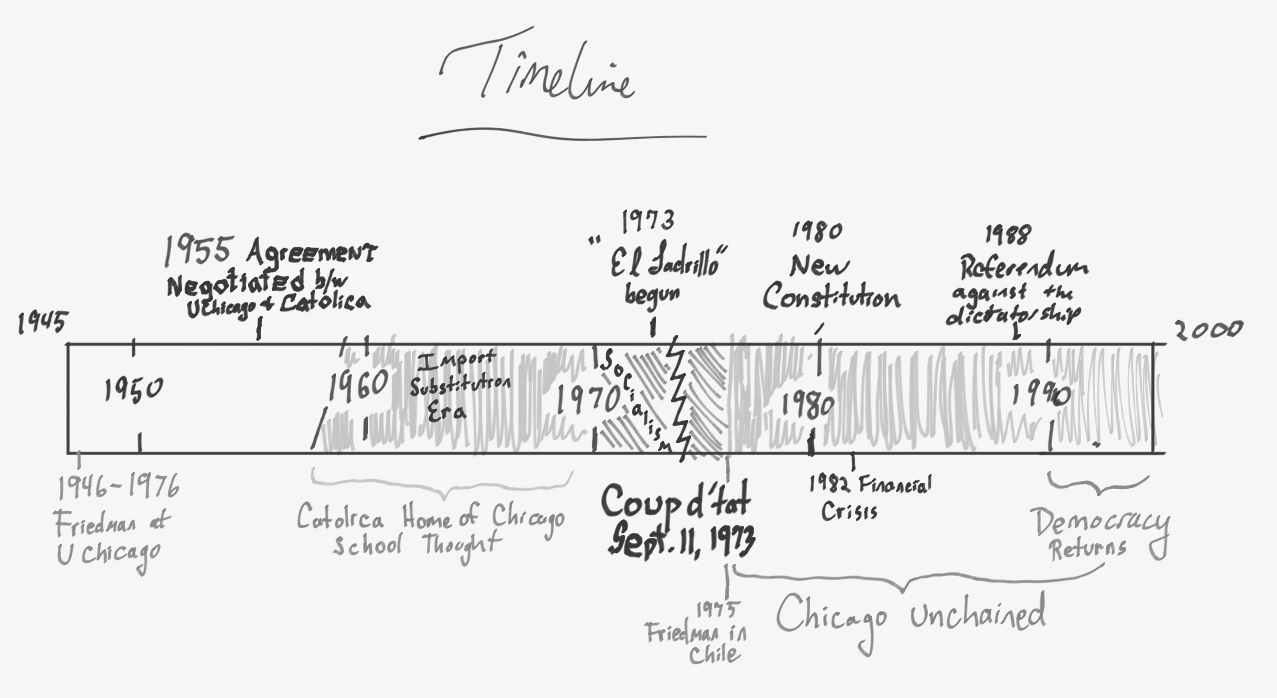
My handmade timeline. I didn't even try to fix my handwriting. Make a pretty version and send it to me please.

Wrath-Kindled Gentlemen

In 1975 Michel Foucault told a left-wing activist “Chile’s tragedy is not the result of the Chilean people’s failure, but the result of the serious mistakes in the monstrous responsibility of you, Marxists.”

Two years earlier on July 29th, 1973, the Second Armored Regiment of Chile rolled six tanks and several trucks into downtown Santiago towards the presidential palace to overthrow the government. Soon a host of other military units would join them to bring down the socialist government of Salvador Allende, which had taken a wrecking ball to the nation’s already precarious financial stability. The other military units did come, but not to join them; those units that put down the coup and restored democratic order were led by none other than Augusto Pinochet.

44 days later on September 11, 1973 that same general, now commander-in-chief Augusto Pinochet, would himself be leading the coup against the government. What could cause such a shift? Was it merely the insubordination of the Second Armored Officers? Or did something change between July and September? I see several reasons that could explain his shift beyond the obvious.

Firstly, the government elected in 1970 had taken farms, factories, and the world’s largest copper mine from the hands of private owners without compensation. They took direct control of nitrate, telecom companies, banking, insurance companies, “monopolistic” manufacturing, and foreign trade. The unions would go on strike at a company and the government would declare the company distressed and seize control. The dubious legality and overt ideological motivations of the government made the military uncomfortable.

Chilean firms with US financial support had tried to prevent the Marxist government from taking office in 1970. But the only result was murderous anti-communists got as far as killing a General whom they tried to kidnap. Other attempts at stopping the transition of power through the legitimate political means failed, but together the violence and attempted political maneuvers had reinforced the tragic revolutionary/counterrevolutionary dynamic of the Cold War. The Allende government tightened its grip and clenched its teeth to bear down on their ruinous agenda.

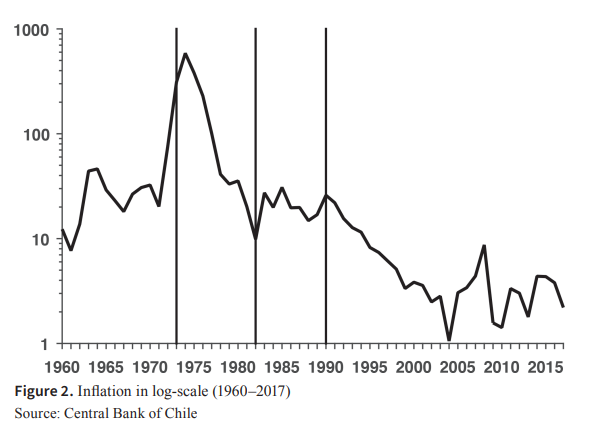
Secondly, the economy under the Finance Minister and union leader Américo Zorilla, a man with a high school degree and no economics training, was in a tailspin. Inflation had passed 300%. Foreign investment disappeared. Exports plummeted. Fernando Flores took control of the Finance Ministry in 1972, inflation hit 500+%. The paychecks of the military were at stake as well. Even in 1969 during the prior government, some soldiers led a demonstration about low pay. Everyone was striking. Doctors were striking. Miners were striking. Even the domestic workers were striking.

Thirdly, sheer inevitability. There had already been one military coup attempt by lower officers (two if you count some abandoned 1970 plans). Now on August 22nd, the lower chamber of congress acknowledged that the military and government were on a collision course. They sided with the military. In that August 22nd legislation, the lower house outlined the abuses of the Allende government and voted 81- 47 that military “presence must be directed toward the full restoration of constitutional rule and of the rule of the laws of democratic coexistence, which is indispensable to guaranteeing Chile’s institutional stability, civil peace, security, and development” and thus it “is their duty to put an immediate end to all situations herein referred to that breach the Constitution and the laws of the land with the goal of redirecting government activity toward the path of Law and ensuring the constitutional order of our Nation and the essential underpinnings of democratic coexistence among Chileans.”

Sounds like permission to do a coup.

A few weeks earlier towards the beginning of August, Allende appointed the Army’s General Pinochet to commander-in-chief of the armed forces after the previous commander resigned. According to one of Salvador Allende’s biographers, Victor Figueroa Clark, the coup was a matter not of if, but when. The bloody pendulum of military usurpation was already swinging down to strike its blow against the incompetent regime. The only question for Pinochet was whether he would align with this inexorable force.

In the darkness of morning of September 11th the coup was officially launched. The Navy returned to port during a military exercise. By mid-morning, the government understood that a full scale coup was in effect. Allende tried to call Pinochet multiple times to come save the government from the mutinous navy. “Poor Augusto, he must be under arrest,” Allende is reported as saying. Allende learned soon after who the poor man must be. It was not Pinochet.

Although he refused to surrender or to go into exile, Allende made a final radio speech to his comrades and friends and well-wishers around the world and bade adieu. In several ways, revolutionary socialism died by its own hand. Military dictatorship and the secret police followed.


Such drama demands a screenplay.

Out of three top hits for YouTube documentaries, not one mentions the state of the economy, nor the congressional resolution (of debatable legality, but interesting and important nonetheless!), nor the prior coup attempt. In one, Cambridge’s Nicholas O’Shaughnessy simply asserts that Allende’s policies were “no different from the social welfare policies of northern European nations.” Does that hold up to scrutiny? Ubiquitous price controls do not a successful Sweden make. One excellent audio documentary series, The Santiago Boys, never gives the impression that Allende’s own policies were to blame for the economic tailspin. It’s always Nixon, Kissinger, and ITT (International Telephone & Telegraph) or the vague and unjustified ideological animosity of of the military establishment and “capitalists” towards Allende.

Historical memory has settled on a misleading hagiography. The drama is better than that! It’s a Shakespearean drama: Richard II and Henry IV. We have Allende’s radical quixotic socialism with dire consequences for economy and democracy – as well as Pinochet’s sudden betrayal and violent political oppression combined with the eventual turn towards economic freedom.

Mixed emotions of catharsis and woe, of relief and horror, of wonder and awe would be much more appropriate reactions to the political degradation and economic history of Chile.

John Cochrane is licking his lips right now.
When your inflation chart is a log-scale something has gone seriously wrong.
How often does a regime's abuse record actually look like this?

The Chile Project

How did a dictator in Latin America wind up deploying the economic reforms of a Margaret Thatcher four years before she came to be prime minister?

It goes back to the University of Chicago, which trained Chilean economists as part of a program called “The Chile Project.” This government-funded project launched in 1955 was meant to provide aid to Chile. George Shultz one of the leaders of the program told the US Government that he didn’t know how to run an aid program. But he knew how to teach economics.

An agreement was negotiated with the Pontifical Catholic University of Chile (Católica) for graduate students to come to Chicago to learn economics. In exchange the students would teach at Católica for at least two years. Chicago Economics Department Chair Theodore Schultz and economist Arnold Harberger ran the program.

The Chicago Boys, as they are called, were a collection of the Chilean students who would modernize the economics department at Católica. They replaced such horrors as a capstone class in Mercería in which students would learn to identify cloths by touch so as to impose the correct tariff on them with more becoming courses on price theory, exchange rate equilibria, contract theory.

The students matriculating into Chicago were not particularly ready for the modern economics graduate curriculum and took mid-level undergraduate courses as well. There they read the first eight chapters of Alfred Marshall’s Introduction to Economics as well as Penny Capitalism: A Guatemalan Indian Economy by Sol Tax and the labor market work by Chile program director H. Gregg Lewis.

Back in Chile these students turned into demanding professors. Sergio De Castro, Emilio Sanfuentes, and others taught and wrote and researched at Católica. In 1963 they founded a research journal Cuadernos de Economía Notebooks on Economy. Pablo Baraona and Ricardo Ffrench-Davis were the editors.

In 1965, a think tank, Centro de Estudios de Sociales y Economía sprung up. Emilio Sanfuentes took over the economics wing of the think tank. The think tank was promoted by Augustín Edwards who also owned the largest newspaper El Mercurio which opened up a column on finance and economics. There popular versions of economic arguments could make a public play. In a three year period (1967-1970) the Chicago Boys and allies pumped 170 articles into the market friendly El Mercurio, putting their ideas into the arena of praise and ridicule and denigration.

El Mercurio was one of a small handful of media organizations that continued to get an additional subsidy via the United States’ CIA which feared, just as the newspaper’s owner did, a wave of Cuban-like revolutions sweeping Latin America.

During the 1970 presidential campaign a few of the Chicago Boys were asked to draft an economic proposal for the Jorge Alessandri campaign. Allegedly, the proposals were so radical in the eyes of the industrialist that he exclaimed, “Get those crazy men out of here; and make sure they never come back.” Nonetheless, the practice of writing a policy brief would be put to good use.


“Cybernetic Socialism”

Meanwhile in Allende’s government expropriation of businesses, massive state control of prices, and expansive social spending was supposed to bring about a new Republic of “endless wine and empanadas.” It was not working so well. The economy tanked (stats!). What to do?

Allende’s government was drowning in the struggles of owning the economy. If only there was some system for dynamically allocating goods and efforts under conditions of scarcity. Discover bottlenecks, push out productive possibilities frontier… It sounds like a job for the budding field of cybernetics! They called up British cybernetic consultant Stafford Beer of “the purpose of a system is what it does” fame. Stafford Beer would build the system that would save not only the economy but Allende, socialism, and the future of civilization: “cybersyn,” a dream of cybernetic socialism

Even today the romance hasn’t worn off. Evgeny Morozov writes “The Santiago Boys… try to wrestle control over technology from multinationals and intelligence agencies and use it to create a more egalitarian economy.” But narrative framing only goes so far. What is really needed to be wooed by the forces of cybernetic socialism is the wonderful mock-up of the economic control room.

It’s the Jedi council for philosopher-kings. Nous sommes l’État.

Thanks to the invitation of economist Fernando Flores, Stafford Beer comes to Chile and will save the day. First stop: the center for economic planning, Ministeria Economia. There he wants to learn what models are being used to set prices. Actually, there are no models. Businesses propose a new price, the ministry approves a smaller mark up, and they go back and forth like that. Sometimes files are “misplaced”, or expedited, or easily approved, or given special scrutiny. Depends of course on favors. Beer wants to know how general equilibrium effects are calculated. Well, they aren’t.

A mathematician in the ministry offers to be helpful. We have a computer which can calculate cross-sector supply requirements. “How many industries are included in the model?” Beer asks. The young mathematician says something like 50 or 15. The translator clarifies that it is 15. Beer, “But, my friend, you really want to determine true, social equilibrium pricing for 3,000 goods with a 15 sector input-output matrix?”

Alas, before the dream of cybernetic socialism could be realized (or even wrestle down the union leaders who objected to quantification of worker ops) Cybersyn was destroyed along with the Allende government. It had connected 12 telex machines to the main hub of a 64kb memory IBM 360 Model 50. Such rigs existed already around the world. But what made this one distinct is not that it was socialists pre-empting the Internet, but rather that it was in the service of a centralized economy. They succeeded in mapping the operations of a handful of factories. The knowledge problem went uncracked.


Origins of New Economic Policy

In December 1972 a retired Navy Officer Roberto Kelly and Admiral Toribio met and agreed that if the government was going to be toppled the military needed an economic plan so that they could get out of the economic mess. Kelly knew Emilio Sanfuentes at the Centro de Estudias Sociales y Economia would be right for the job. He approached Sanfuentes and requested a report.

Eleven economists got to work on a type of confidential white paper. 9 had Masters’ degrees in Economics from the University of Chicago, one from Harvard, one from Católica. Sanfuentes was the go between with the client, who was the Navy, and Sergio de Castro was main editor of the project.

The final document is known to history as El Ladrillo THE BRICK because it was so thick. Several inches, they said. The original name of the daring policy proposal was the very unobtrusive Programa de desarollo economico, A Program for Economic Development. I was personally disappointed to discover that the foundational document of Chilean economics only had 200 pages. For an Admiral in the Navy, though, that might be an intimidating amount: a veritable brick.

El Ladrillo has all the marks of a market based set of policy proposals written by people who were accustomed to integrating Catholic social teaching and motivations. And it came naturally. It was written by members from the Pontifical Catholic University who thought of economics as a moral science. For example, when discussing the difficulty of disbursing poverty relief, they acknowledge that in a poor country fact checking eligibility in advance will be very difficult and very expensive. But they reasoned that the optimal amount of fraud is not zero. It is preferable to have some fraud if it ensures that the poorest citizens of Chile are “able to live lives with some degree of dignity.”

The economists did not conceive or write about their project as a type of neoliberalism. At the time the term ‘neoliberalism’ was associated with German reforms under Adenauer. Instead they saw the Chicago project as a type of subsidiarity, the concept in mainly Catholic political theory that decisions should be made at the lowest possible level to solve problems. The decentralization of free markets naturally does this by allowing firms and decision-making to discover the right size for their purposes.

At the same time, the proposals found in El Ladrillo are the types of policies one would expect from modern economists taught by Gary Becker, Milton Friedman, and Arnold Harberger: tariff reduction, removing subsidies and government protections of industries, removing all price controls, decreasing fiscal spending, making the central bank independent, allowing the currency to float. The Chicago Boys had taught Marshall’s Principles and Friedman’s Price Theory at Católica. Inevitably those influences were a lion’s share.

Other specific influences include Albert Hirschmann, who had done a 1963 study on the history of Chilean inflation, and Al Harberger, who had done research on Chilean inflation dynamics.

Although not finished in the promised 90 days, the document was completed in time for the coup.

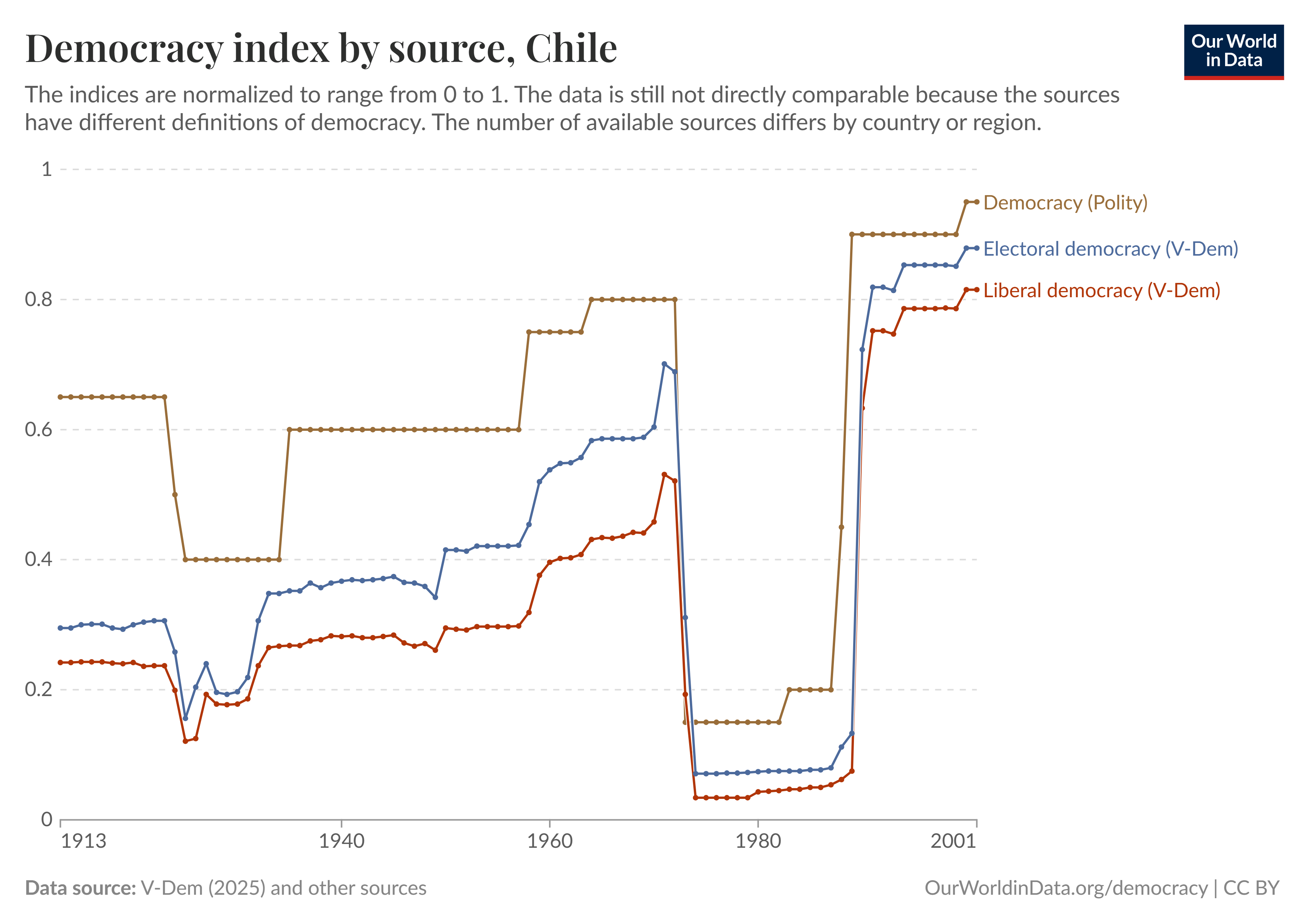
The slope of the Democracy curve is the 6 hours it took to establish a dictatorship.

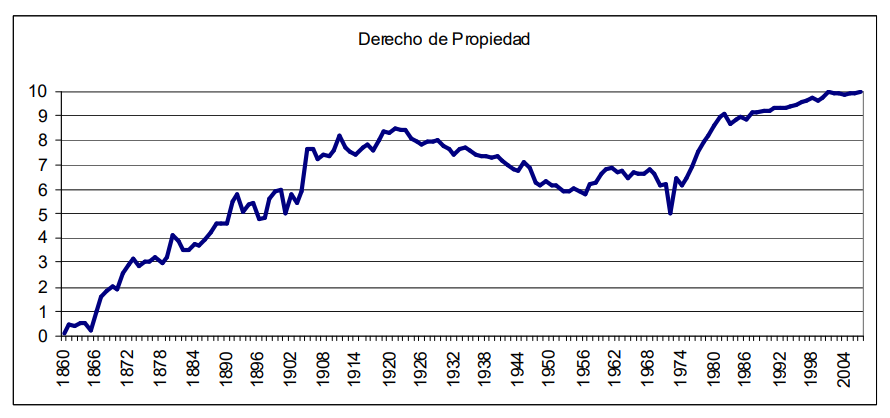
Above is a Yearly Property Rights scale based on a 1-10 Index, sc. Rodrigo, Saravia 2009.

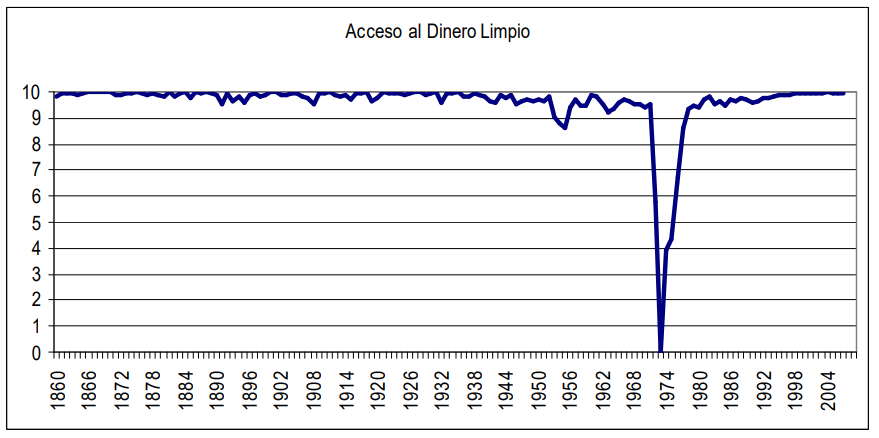
Above is an index of access to clean, unlaundered money on a 1-10 Index, sc. Rodrigo, Saravia 2009.

Three days after the coup Sergio de Castro was quickly appointed to the government as senior advisor to the military officer in charge of the economy, General Rodolfo Gonzalez. Gonzalez showed De Castro one of the 25 printed copies of The Brick and said implement this. In fact, De Castro knew the document well already; he had written it.

To fight inflation at almost 700% de Castro removed price controls on as many goods as the military would allow. (Always amazing how many goods become national security related, when you have the power to control their flow…) Nonetheless, thousands of goods started to have market floating prices. A cooking oil business shows up to de Castro’s office and requests a price increase on oil. They provide a well-prepared document showing the the need for a price increase. De Castro responds. “I don’t need to see this. Set the price to whatever you want.” The business leaders leave insulted.

They return a week later. “I don’t need to see it. Truly. Set the price to whatever you want. If you set it too high the oil won’t sell, if you set it too low, you’ll lose a lot of money.” The business leaders left confused.

They check in one last time. ‘Can we really set the price to whatever we want?’


Milton Friedman Speaks

Milton Friedman visited Chile three times, but it was his first visit that really mattered for him and for Chile.

If Fernando Flores tried to move the economy through the consultation of Stafford Beer, Rolf Lüders tried to do so through his famous invitation to his teacher Milton Friedman.

Milton Friedman had had some of the Chilean economists in classes, but mutual contact was not a big part of either of their lives. Though there was certainly indirect influence and much agreement between Friedman and the type of economic policies promoted by El Ladrillo (a document he didn’t know about), Friedman was not heavily involved with, nor in contact with, any of the Chilean economists except for Rolf. Nor did he serve an advisory role in any of their deliberations.

Nonetheless when he visited Chile for the first time in 1975, in my reading he had a big effect. Friedman along with Al Harberger met with Pinochet for 45 minutes. One condition of the meeting was Friedman wanted to be able to say whatever he wanted. Every interaction had the same drum beat. You need a price system, you need markets, in the current system there is massive waste because no one knows what to build and how much. People need freedom to choose their economic fates.

Friedman told Pinochet he needed to stop inflation through immediate fiscal austerity and that freeing finance, labor market, and prices was the only way to produce growth and reduce poverty.

Two days later, Friedman spoke to several hundred business people at an event organized by Rolf Lüders. He advocated the same immediate change of course in Chilean economy (end state owned enterprises, decrease tariff barriers) and then engaged in Q&A for over an hour. 22 questions were asked – some accusatory, some surprised.

And again he met with 200 military officers to tell them how to save their country. His drum continued to the same beat. End. Price. Controls. End them on Goods. On Labor. On Loans.

The Chicago Boys have gone out of their way to distance themselves from Milton Friedman as an influence and cause of their success. They were much closer to their friend and mentor Al Harberger. Nonetheless, based on the timeline of subsequent events, it seems that Friedman altered the political economy within Chile.

Within the military government there were two camps: the democratic leaning military leaders and the national security military leaders. The democratic leaning military leaders were more willing to release some power back to the private sector or the non-military public sector. The national security military leaders believed in a strong state that controlled many aspects of the economy and all of civil society, from universities to manufacturing, for national security reasons, of course.

Manuel Contreras, the director of national intelligence and architect behind assassinations abroad, domestic kidnappings, and frequent tortures at home, believed the Chicago boys were intellectual traitors to Chile. The true goal of these upstarts who studied abroad was to deliver Chilean industries into the hands of international actors in order to line their own pockets. By 1975 he had collected “thick files on the personal activities of each of them.”

The American ambassador in an internal memo noted that the main opposition to personal rights and just criminal proceedings in Chile was Contreras. Contreras’ own story of power ended in 1977 when Pinochet dismissed him for pulling too hard on the leash. The standard theory is that Contreras brought too many diplomatic headaches with his human rights abuses and permissionless assassination of Chileans abroad. Political oppression should be subtler.

After Friedman’s visit, military statists started to lose ground and the Chicago educated economists gained ground. Pinochet starting appointing private citizens to high cabinet posts, not merely to advisory ones.

Consider the following dates of Chicago Boys assuming senior roles in government. This first round of major hires and promotions were all after Milton’s 1975 visit. I take this as evidence of a “Milton effect.”

Sergio De Castro: Minister of Economy 1975-76, Minister of Finance 1976-82.
Pablo Baraona: President Banco de Chile 1975-76, Minister of Economy 1976-78
Sergio De la Cuadra: VP Banco De Chile 1977-81
Alvaro Bardon: President Banco de Chile 1977-81
Miguel Kast: Director of Planning 1978-81

When I look at this data my initial thought is to conceive Friedman as a kind of voice of reason for the military government. Like a CEO who wants to change the org chart and operational structure but first wants someone from McKinsey to tell him to do it, Pinochet and his military apparatus needed the little push from this famous outsider to hand over the keys to economic reform to Sergio de Castro and his American educated colleagues. An outside voice can create permission and coordination within any regime.

It is not that Friedman and the Chicago boys coordinated their actions, rather, they both pushed in the same direction. Nor was Friedman the godfather of the reforms or the secret counselor to the Chicago boys. His influence is the more diffuse – like that of a major brick layer in the grand edifice, the edifice of monetarist economics and promotion of the price system view of the world. Milton was an architect of an edifice which the Católica academic economists also worked on and eventually put into practice.

Friedman’s Reward

Friedman’s reward for his candid advice to the Chilean people was protests at all his public appearances, an interruption at the Nobel Prize ceremony, and a general vitriol that he would visit this particular dictator.

At the Nobel Prize ceremony a young activist was able to use his father’s ticket to con a seat. Then he waited for a dramatic moment of silence after the introduction of Milton Friedman to King of Sweden. He stood up with great gesticulation and shouted, “Down with Capitalism.”

Friedman reflected on those events 25 years later for a PBS interview in 2000 and had this to say:

 The Communists were determined to overthrow Pinochet. It was very important to them, because Allende’s regime, they thought, was going to bring a communist state in through regular political channels, not by revolution. And here, Pinochet overthrew that. They were determined to discredit Pinochet. As a result, they were going to discredit anybody who had anything to do with him. And in that connection, I was subject to abuse in the sense that there were large demonstrations against me at the Nobel ceremonies in Stockholm. I remember seeing the same faces in the crowd in a talk in Chicago and a talk in Santiago. And there was no doubt that there was a concerted effort to tar and feather me.

We know also that Friedman’s dealing with Chile were beneficent and nonpartisan. He refused honorary degrees from government run Chilean universities, stating that state involvement as his reason. Al Harberger vouches that Friedman stated over and over again his belief that decentralization of markets would undermine centralization in politics, including in his university speech “The Fragility of Freedom.” But there is some tension in this with what he said in Capitalism and Freedom. Autocrats may coexist with free markets for a time.

Furthermore he was directly helpful to one non-Chicago educated Chilean. Our cybernetics friend Fernando Flores, the Minister of Economics from the Allende government, had been in prison for three years and not allowed to leave the country. Friedman, never having met him, intervened on behalf of his freedom.

“Like many another friend of Chile, who is also a believer in human freedom and liberty, I have been greatly distressed by the restrictions on personal and human freedom in Chile that have been widely circulated in the West. . . . The immediate occasion for this letter is the case of a former Allende cabinet minister under detention in Chile, Fernando Flores Labra. . . . I have never met Mr. Flores personally and have had no direct contact with him. However, I have been led to inform myself about him. As I understand it, Fernando Flores is legally eligible for a US visa under US immigration laws, Stanford University has offered him a position in its Computer Science Department, and Chile has not granted him permission to leave the country.

“Freedom is indivisible. Greater economic freedom promotes and facilitates greater political freedom. But equally, greater political freedom promotes economic freedom and it contributes to economic progress and development.”

After Milton’s letter, Flores was released from prison and made his home at UC Santa Barbara. The Spanish language Wikipedia page credits Amnesty International and makes no reference to Friedman’s intervention.


1982 Financial Crisis

In 1982 the Latin American Debt crisis shook Central and South America. Chile was no different. What made the crisis especially bad for Chile was that they neither abolished the central bank and dollarized, nor maintained a floating rate. They pegged, and kept the same peg for two and half years. Why Sergio did this, I don’t know.

In the 60s he had written argumentative papers and engaged in great fracas in favor of a free floating rate. But now the currency is pegged and pinned and wriggling on the wall.

The banks borrowed dollars. They lent in pesos. The investments inflows decreased when oil dropped and copper dropped, so they borrowed more dollars as a bridge loan, until as commodity prices sunk the Andean skis went flying out from under them in an avalanche of bankruptcy, state bailouts, and unemployment.

Friedman had always been against a hard peg. And when the hard peg broke down it was not surprising to Milton that Chile was one of the countries greatly wounded by the crisis. Thus it was not Chicago school orthodoxy that made the 1982 crisis especially bad.

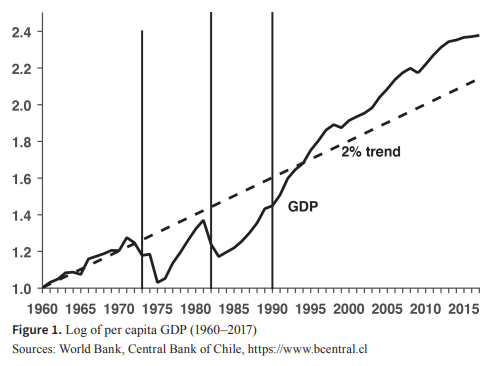
Al Harberger points out that although the Chilean decline was greater than the others, it’s rebound was also stronger.

The Chilean [crisis] was maybe deeper than the others for reasons of it having a large amount of debt to begin with and of this problem coinciding with a copper bust, but anyway, Chile led the continent in climbing out of this recession. It was the only debt-crisis country that got back to the pre-crisis levels of GDP before the end of the decade of the ’80s, so for most of the countries, it was the full decade that they called the “lost decade.” In Chile, it was the better part of it that was lost. But Chile was the first to come out. Chile came out growing at 5, 6 percent per year — and long after. You see, you can say that when you’re in a recovery period, you’re recovering lost ground, [and] it’s reasonable to think you’ll do that fast, but after you’ve recovered the lost ground and you’re going on, if you continue on the same or even increasing trajectory, that’s even more of a miracle. And that is all part of the Chilean picture.

GDP Growth


A Long-Expected Political Transition

In 1980 Pinochet’s government installed a new Constitution. But they held on firmly to the reins of power. Civil authority and citizen freedoms were weak at best.

Even in 1986 the Universities’ top level presidents and administrators were all military officers. Friedman wrote in protest to rector of the University of Chile, General Roberto Soto MacKenney.

“Friedman noted that he had received information that ‘suggests that the universities in Chile in serious danger of having their academic integrity and performance destroyed by the application of arbitrary and irresponsible force [by the military authorities],'” pg. 153.

The Pinochet regime imposed unfreedom.


After the 1982 crisis, Pinochet fired a bunch of people in economic management. He put in more old guard traditional import substitution economists. But when their policies failed to deliver a reduction to inflation and a return to employment, he went back to Católica and found the young guard of Chicago educated economists and put them in.

(I wonder about the internal process here.)

A second round of reforms followed: an independent central bank, privatization of the remaining government owned firms, and a slower paced reopening of the economy than the shock treatment of 1975. The political economy may have worked better because when Pinochet let go the direct reins of power through the referendum of 1988 the Christian Democratic party maintained and continued the basic reform program in 1990.

Pinochet left the presidency, but not power. He retained the position of commander-in-chief of army until 1998. When he went for back surgery in a London clinic in 1998 he was arrested while bedridden with extradition orders to go to Spain, creating an international incident, which is beyond the scope of my research. That satyr play will have to wait.

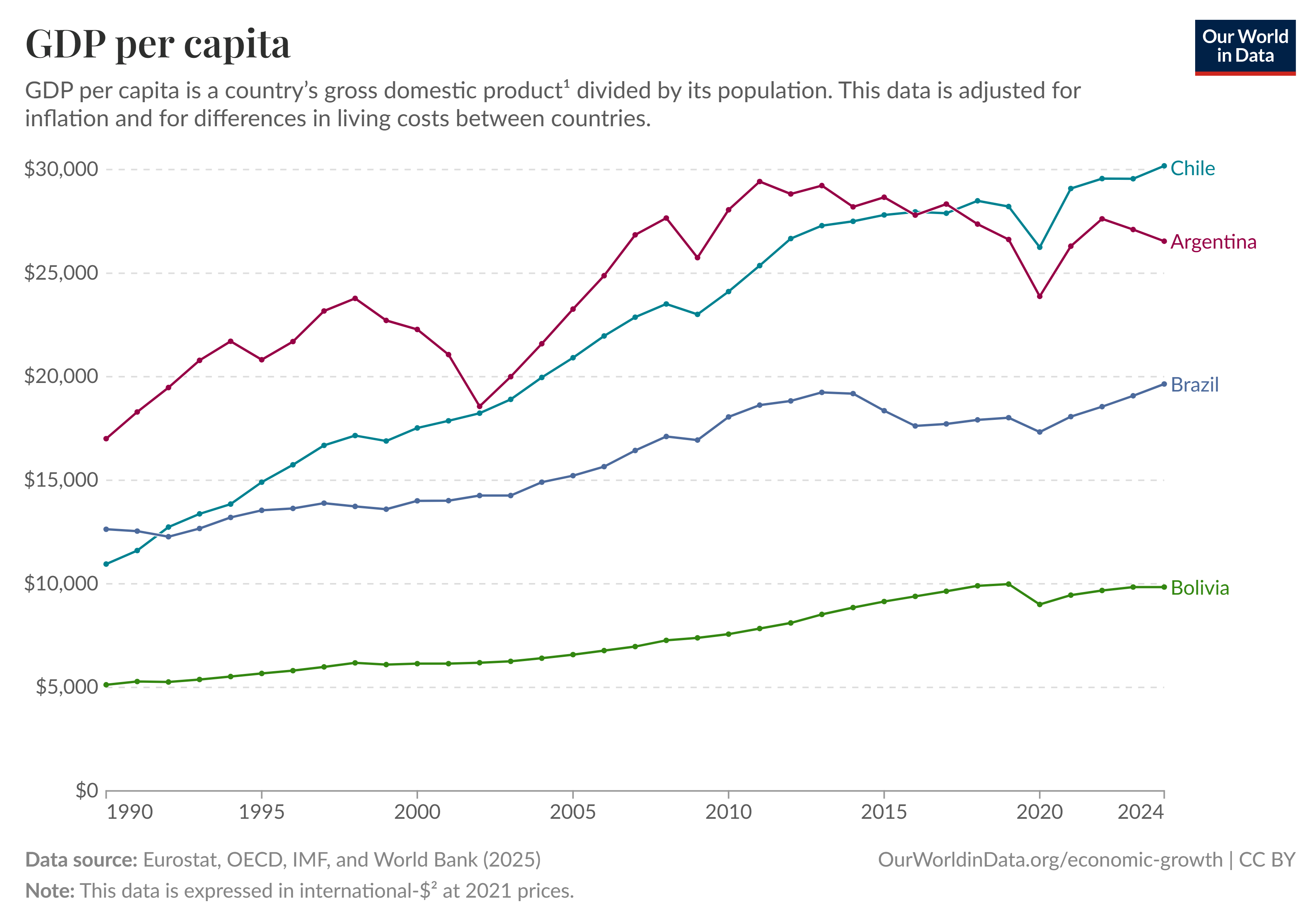
In 2002 Chile equaled Argentina in GDP per capita, and surpassed them clearly by 2018.


Lingering Questions

Remaining Questions I have are in buckets.

Technical questions:

  • How big a problem was the peg during the Latin American debt crisis. Panama, which doesn’t have a central bank, was punished severely anyway. The other Latin American countries with crawling pegs were trounced. The U.S. sported -1.8% GDP growth! So is there really anything Chile could have done?
  • In the 90s Chile put in place import holding rules on capital flows to make them park in the Central bank for a year. Is that a helpful move for preventing a repeat of 1982? Just because Stiglitz thinks so, doesn’t make him wrong.
  • When reading the history of Japanese Finance Minister Matsukata Masayoshi, I was struck by how he altered the tax collection system regime to benefit the fiscal situation, namely by cutting back delays and increasing enforcement. He was still able in effect to decrease the debt issuance of silver-backed debt from a government that didn’t want to cut military spending. What was tax collection and the fiscal history of the dictatorship?
  • Did Milton Friedman really sway the government officials or am I missing details about the regime which made the eventual promotion of civilians into ministries inevitable?
  • Were there Mistakes in the speed and sequencing of the policy changes?
  • There are constant arguments about the pension reforms in Chile. I’d like to know more about these (and other aspects of pension policy theory). The actuarial part of me is excited about this potentiality.
  • Were there meaningful differences between the Bolivian fight against hyperinflation and Chile’s policies?

Dictator Club Questions:

  • Did Spain’s slow liberalization make the politics of Chilean fast liberalization easier?
  • What did Pinochet think of all this economics stuff? I have read once that a Spanish finance minister kept wanting to ask Franco permission to change some large policy. And Franco just waved his hand and said something to effect of “just don’t get me involved.”
  • What did Pinochet do with his time?
  • Did Peronism affect Chile?
  • Did the Brazilian dictatorship affect Chile domestic strategy?
  • How did Allende’s government exercise power?
  • How much were Unidad Popular funded by outside sources?
  • How did Pinochet think? Is it a miracle that a military government allowed these reforms?
  • What percentage of time does inflation over 300% result in a coup?

Annotated Bibliography

Edwards, Sebastián. The Chile Project: The Story of the Chicago Boys and the Downfall of Neoliberalism. Princeton: Princeton University Press, 2023.
The lion’s share of my information came from this volume. The bibliography and endnotes were particularly instructive. Clearly the best book on the subject, especially for a serious general audience.

As part of my intellectual hygiene habits to avoid words that end in “-ISM” I’ve tried to be quite sparing in this article, Nonetheless “socialism” and “capitalism” rear their ugly heads. Similarly there’s no discussion of “neoliberalism” here, although Edwards’ book does an extended treatment of the topic.

Meiselas, Susan, ed. Chile from Within. Photographs by Chilean photographers, texts by Marco de la Parea and Ariel Dorfman. New York: Pantheon Books, 1991.
The photos from the military regime were powerful for evoking a sense of political oppression and the people who resisted it. But the book also talks about the abuelitas who resisted Allende and the abuelitas who resisted Pinochet (often the same!).

Piñera, José. “Salvador Allende’s Chile in Eleven Truths.” Archived at the Internet Archive. Accessed February 7, 2017.
.
God bless archive.org which preserves this excellent website by one of the honorary Chicago Boys. Through José’s website I was able to find the National Assembly’s condemnation of Allende.

De Castro, Sergio. El Ladrillo. Santiago: Centro de Estudios Públicos, 1992.
The original text of El Ladrillo. I haven’t read all of it yet due to my still plodding Spanish. But it is a tremendous framework document. Not nearly as economically technical as I expected. It’s more of a roadmap than a series of prewritten directives for different departments of the economy.

Silva, Carola Fuentes, dir. Chicago Boys. Documentary film. Chile, 2015.
Some good interview snippets, but I wish there was a lot more. It got me thinking about the political pressures and costs of working for military dictatorship and the long-term difficulty of maintaining a positive legacy. Sergio de Castro has had to “ignorance-wash” himself beyond credulity. But to do otherwise is suicidal not only to his reputation but also treasonous to his life’s work to provide good economic policy for Chile. I especially appreciated Ernesto Fontaine’s body language. His candor and “dgaf-iness” I found endearing.

Friedman, Milton, and Rose Friedman. Free to Choose. PBS documentary series. Episode 5, 1980.
This episode had a segment on Chile and included the protests against Friedman at the Nobel Prize ceremony. It was incredibly uncomfortable waiting for the young black-tie protestor to be escorted out.

Morozov, Evgeny. The Santiago Boys. Audio series, 2022.
This series tells the story of Allende’s economic attempt to make a new world free from capitalism. I found it full of good interview snippets, excellent production value, and masterful editorializing. Yet sometimes it was also one of the worst offenders under the banner of “things meant to make the reader think they know something when in fact they know little.” Nonetheless, it was a fun romp.

Whelan, James. Allende: Death of a Marxist Dream. Washington, DC: Regnery Gateway, 1981.
Features lots of interviews with military personnel and others from the coup days. I have barely dipped into it, but it seems to be a very valuable book. I got a much better sense of the scale of the near total public rejection of Allende’s government. And honestly it is just beautiful and excellent journalism.

Larroulet, Cristián, and Fernando Soto-Aguilar. Chile: Economic Freedom 1860–2007. Serie Informe Económico No. 197. Santiago: Libertad y Desarrollo, March 2009.

Caputo, Rodrigo, and Diego Saravia. “The History of Chile.” Working paper. Centre for Experimental Social Sciences, University of Oxford; Universidad de Santiago; Central Bank of Chile, 2021.

Freire, Danilo, John Meadowcroft, David Skarbek, and Eugenia Guerrero. Deaths and Disappearances in the Pinochet Regime: A New Dataset. Working paper, May 30, 2019.

Spanish language Wikipedia was also helpful for things it said and the things it did not say.


Thank you to Sam Enright and the Fitzwilliam for setting me on this quest. I believe this essay will prove one of most definitive outlines on these matters for the general reader — in spite my tone and tense switching and undoubtedly some errors I have made.

Passing the Pillars of Hercules

[This letter is part of the Little Letter Republic, a project whose purpose is to build intellectual community out of St. Louis]

Dear Laura,

There’s a cool video I found on Twitter a few years ago which showed a 1994 workstation and one by one each item transformed itself into an app on the computer until nothing was left on the desk except a laptop. Each item, the phone book, the planner, the telephone, the notepad, the sticky notes, the calendar, all disappeared into the laptop. (I very intentionally retweeted this little video so I could find it again, but somehow still I can’t find it on my timeline. Oh well. I’m not very good at using Twitter.)

I wonder whether something was lost in this transition and something else will rise to take the place of all that empty desk space. I hope so. The flattening of environmental information into openable apps seems to decrease affordances and impoverish the physical environment. Even adding in two external monitors can’t fully fix this.

Let me provide an example. Last week I purchased an analog watch. It has the date and time. The first effect I noticed was that it revealed to me the extent to which “checking the time” is pretext for checking notifications. Pulling out my phone every time I want to know the time is a lot of work. And further, a time check on a phone costs a lot of cognitive resources. I am no longer paying the notification tax in order to know the time, and it is great. (Yes, most apps have notifications turned off. Still super valuable.)

So I’m wondering, what else in my physical environment am I missing? What else should I be doing or could be built that enhances our experience of daily life. The influence of Factorio on culture teaches “it is a mortal sin for something that is used less often to get in the way of something used more often.” My pocket, my earbuds case, the side button, and the email notifications were in the way of telling time. Now they are not.

A key term I’m thinking about here is affordances. Affordances come from behavioral psychology as an idea for explaining how the mind picks up on certain environmental cues to perform specific behaviors – very similar to the idea of “prepared spaces.” Whether a space is prepared or not really matters towards what actions will be performed in that space.

And just as spaces matter so too do the tools and their receptivity to the user’s touch and purpose.

I am a Stan fan of e-ink, but I lost my religion when I received a copy of the Daylight computer (which I am writing this on while I fly). E-ink is beautiful, high-contrast black and white — well, it’s pretty close to white. My Boox could last weeks on a single charge and the software was an excellent multi tool with good integrations. But the Boox is like 4hz. The Daylight is 60hz. And that responsiveness makes up for literally 100 hundred unique defects in the device. Reliability and speed and response make a user experience feel embodied and connected, while randomness, sluggishness, and lag do not. Writing on a pad with a pencil has a reliability to it and an immediateness that is hard to replicate.

I find the Daylight experience generalizes. Digital vs physical chemistry experiments are like this too. The virtual lab is not immediacy in a box. A bookshelf is immediate. I love to meditate on the topics contained on my shelves. My displayed books guide and shape my thoughts and what I think about and what I value. I’m a mere man, visually stimulated by these to think about the things I want to think about. I cannot sit in a dark room and expect my thoughts to grow brighter. I need the totems. But I wonder what totems new and old can be brought into the intentionally prepared spaces of the future.

The totems of long cogent word strings are books. The totems of music were once CDs, in our house they are now Tonies and those library book audio things, and vinyl. The totem of math is the abacus, magic square, and calculator, but hey I’m up for learning slide rules. I used to be deft with a soroban, and sometimes I wonder if I should have a separate tablet for every app and app combo… Obviously with a suggestion like “one app one device” I am moving I the wrong direction here… Or am I?

Changing topics back to prepared spaces. Imagine a science house where dozens of experiments are set up and ready to go – a kind of touring tutorial on a single topic. I like to think of it as a library of discovery.

Say I want to explore combustion. So I have a space dedicated to Michael Faraday’s *Chemical History of a Candle*. We have updated versions of all of the experiments in those lectures. Identifying the hottest part of a candle. Identifying where on a candle the fire actually takes place and what it is made of and how the smoke from a candle can be lit and how to show that water is a product of combustion even when there is no water in the air and no water in the candle. All those experiments set up yes, but also giant flippable flashcards of leading questions whose answer are provided after the experiment. A comparison and contrast with the modern equipment with the original equipment used for the experiment.From there we move back to Boyle and the discovery of vacuums. We use pumps to remove air and change air pressure in a variety of pumps and move different sized objects using the power of air pressure and vacuum. We build a piston and crankshaft converting [rotational energy] out of [pressure]. Along the way we reveal several major applications. Water pumps, turbines, pistons.

From there we go to the internal combustion engine room. We take the machined parts of a single piston engine and put it together, then we explore all the design flaws of the single piston and slowly come up with a four cylinder engine. Valves open and close, engine casing, oilng, cooling system, exhaust system each receive their own treatment. At the end such a process, we have explored a huge portion of science and engineering.

The biggest barrier in my opinion to any of this is space. Making good spaces is expensive. However, that doesn’t mean we shouldn’t try and showcase just what a good space can be and do for learners. I am hopeful for a future where we have the resources to build and experiment with more such spaces – at schools that specialize in this type of work AND rotating exhibits around the country AND “science sites” within a single city spreading the real estate cost across a metro area so that educational institutions can take turns using the same systems.

What We Will Become Has Not Yet Been Revealed

[This letter is part of the Little Letter Republic, a project whose purpose is to build community intellectual community.]

Dear Gavin,

I enjoyed your rumination on the difference between traditionalists and rationalists. As you know, these terms are so fuzzy, inexact, and frequently misleading. Yet for me, despite their vagueness, both referents remain deeply important. I don’t know how much I can add to your already well-vibed dichotomy, but perhaps somewhere in our separate approaches we can find a delta in our understanding out of which new insights might emerge.

Robinson Jeffers wrote: “The cold passion for truth hunts in no pack.”

And given that I’ve been on a deep Leibniz kick these past two months, I see him as a man with no pack, and thus relevant to our conversation. The reason is this: Leibniz models the rare ability to amalgamate traditional paradigmatic questions with modern lines of inquiry. He never stops seeing the old as useful, even when it is no longer correct. He can see what remains fruitful in a method even when large portions of doctrine prove inadequate to the task at hand. Yet, his love and recognition of the new does not yield to infatuation; he is constant and incessant critic as well as devotee. He is not afraid to posit replacements to the old or the new. I think it is precisely his ability to navigate multiple paradigms that yields his dozens (scores?) of right insights — insights on space relativity, binary arithmetic, the necessity of grounding metaphysics in more than mathematical objects, the consciousness of animals, to name but a few against the many currents of his times. Not only that, but Leibniz had the rage of youth — and you know how much I love the rage of youth. Who doesn’t want to solve all philosophical problems with a clear and distinct logical system built atop universally accessible intuitive primitives? I know I do.

And then there are his world-shaking quotes, like (to paraphrase): “I judge the man more worthy of esteem and honors who has cured a single disease than he who has found the area under a curve.” (Written before he himself did the latter.) Also, his mathematical explanations are actually lucid to me — a shocking feat for clarity. His letters display this same clarity of expression.

By my Fermi estimate, he wrote for four to five hours a day, every day of his life. And yet, no one is a real “Leibnizian” in the way that someone can be an Aristotelian, a Cartesian, or a Kantian.

On the one hand, I find this quite sad. How can someone who wrote ten times more than any of his contemporaries create such diffuse influence without founding a true school of thought? He didn’t cultivate disciples, teach formally, or publish didactic works. He didn’t build charisma. He just built content and followed his many methods. He developed methods that others took on and extended: a huge influencer through sheer quantity of insights and correspondence (nevertheless it never seems like he has the right correspondents).

Perhaps this is just as well. A Leibniz doesn’t need an “-ism” named after him. The key to rigorous and right thinking is using all tools at one’s disposal to understand the many facets of reality. Maybe Leibniz’s “hedgehog in a fox mech suit” approach to intellectual life is non-reproducible—or, as I sometimes worry, even anti-mimetic.

That's not a fox, it's a bunch of hedgehogs in a mech suit.

You’ve taught more workshops on rationality than I have. Is it teachable? I think so, but it is hard without good contextual questions. Tradition can be taught and can be lived, but can innovation and “the new life of the mind” be taught in quite the same way (though Matt Clancy has made me more bullish that useful innovation can be its own sort of tradition)? Nonetheless, only through a community of practice can one build the synthesis of approaches that you and I both want to see in the world.

In Maria Rosa Antognazza’s intellectual biography of Leibniz, I hear her philosopher groans: that Gottfried spent so much time on practical matters, on inconsequential Germanic politics, on his practical schemes, political projects, and writings on the esoterica of binary were distractions from his true calling—the development of the Monadology and his other dozen philosophical projects. The terrifying object here is the implicit assumption that the intellectual life is defined by the questions treated by academic philosophy. There is a real sense in her writing that he squandered his gifts as a philosopher by pursuing so many interests outside it. But is philosophy the only game in town?

I think Leibniz believed—or at least what I like to believe myself—is that philosophy is a way of life, a habit of mind, and a set of all sets of inquiry, not a distinct discipline. To make it into its own discipline is to turn it into a Glass Bead Game. The whole Great Books and Classics ecosystem might prepare some of the best Glass Bead Game players around—and I honor the game! But does it prepare one for discovery, action, and becoming one of those lights that supplies the beads for the game? For that, one needs practical wisdom, the art of rationality, applied history and economics, and of course, the philosophical disposition.

As I wrote recently, the classical quest for virtue is greatly complemented by modern tools, and the modern context is sufficiently different that the intellectual demands of prudence and justice are much greater than before. An analogy that might resonate with the traditional ethicist is that of extraordinary medical care. In the Thomistic tradition of medical ethics, providing medical care is obligatory if it is ordinary, but not if it is extraordinary — and the difference between ordinary and extraordinary is circumstantial. The generic heart pill we might have a moral duty to supply in the USA in 2025 was utterly beyond society’s capacity in 1905. Moral duties are contextually realized, not imposed by synthetic a priori reasoning upon the universal kingdom of ends. In the same way, the demands of prudence and justice shift with context. Prudence and justice are more demanding now than in the past for the demands rise as our capacity does.

Thus I expect today’s great leaders to have a firm grasp of economics, probability, game theory, transaction costs, coordinating mechanisms, elasticity, and incidence, not to mention several fields of science, history, and philosophy. I think the standards simply must be higher.

Furthermore, the seduction of the world of ideas is that we might come to confuse the clear and distinct ideas of philosophers for the world itself. The most important things in history, and the most important things in our lives, are not necessarily those that are easily talked about in didactic treatises or rigorous formalizations. (And yet those rigorous formalizations come from somewhere.) They emerge from wading into the algae-filled pool of history and embodied, carbon-based stuff, and trying to pull out abstractions and generalizations and statistics and causal explanations that work.

So far I am in full agreement of temperament with you, and yet. And yet. And yet.

Perhaps there is a weird quirk here being underplayed, and that is the importance of being a bearer of a tradition. (This goes back to my writings on identity and politics). The iconoclast by temperament might not like the stodgy and inflexible bearers of a dead or dying intellectual tradition, yet it seems to me very terrible not to have them around. The majority of people will be establishment people by nature, preferring convention and authority, not desiring to exploit a good intellectual arbitrage or find contradictions in Torah or respond to thirteen objections to a proposition. So I think it is very important that the majority of education is about passing along the Burke-processed fundamentals with their priorities, paradoxes, and unanswered questions, but most of all that sincere belief in the study of authorities as a useful scaffold to knowledge of Divine things and human benefit. As a matter of temperament, I cherish exploration and think new tools and their development is necessary for a good and successful vita activa.

But as an empirical matter, we are not near the point of saturating our world enough with either the “traditionalist” Way of Wisdom or the “rationalist” Way of Calibrations approach to the intellectual life.

The Education of Gottfried Leibniz

[This letter is part of the Little Letter Republic, a project whose purpose is to build community intellectual community.]

Dear Henrik,

You likely are wondering about the education of Gottfried Leibniz.

But let’s start with a 17th century pedagogical theory called Ramism developed 100 years prior, a virus spreading throughout Protestant Central Europe. We might call it a form of reductionism and an aggressive simplification of the curriculum, curriculum requirements, of the categories in philosophy and metaphysics, and the promotion of new tabular methods for pedagogy that trade off exactitude and nuance for ease of use. It was wildly successful, influential, loathed, and hated, and achieved a semi victory, that lasts to this day.

Here’s what the Ramists believed.

There are two types of philosophers, those who make easy to recall dichotomies and those who don’t i.e. dastardly Aristotelians. Among those who make dichotomies there are the Ramists and the Semi-ramists. The Ramists require all things be organized into pedagogically satisfying charts and the Semi-ramists only require most things. There are two types of Ramists, the ones who emphasize the doctrines of Ramus and the ones who spend all their time attacking Aristotle, Plato, Cicero, and Quintillian for being too obtuse and poorly structured. For the Ramists there are two doctrines: 1) All knowledge is a form of dichotomous categorization. 2) Philosophy should be immediately evident and empirical. There are two types of philosophy: physics and logic. Physics should be based on math and simple observation. Logic should also be based on math and simple observation. Anything too complicated is likely not true, because true things are useful, and complicated things are not useful, and thus not true!

Leibniz was influenced by it greatly. Many later Ramists were interested in the mad quest to reduce ideas into primitive notions which could be combinatorially combined along with rules to create all possible ideas, like some mad Principia Mathematica or Peano Arithmetic for philosophy. Some post-Ramists were encyclopaedists looking to reconcile the sciences and philosophies of the day. What could be more useful than theological and political harmony in days torn by confessional, political, and philosophical divisions!

Leibniz went to an Orthodox Lutheran school in the very Orthodox Lutheran town of Leipzig in which the reading list was tightly curated for Lutheran Orthodoxy. At this school, he learned excellent Latin which was the language in which all of his writings, essays, and conversations had to take place. And as far as it went, it was solid. The secret sauce, though, was his father’s death when he was 8 years old. His father was a pastor and professor of theology and his library contained many books from the various confessions Reformed, Lutheran, and Catholic. The library was locked. A noble in town interceded on behalf of the young Gottfried to unlock this library and allow him free reign, despite the objections of the schoolmasters. Enter the autodidact.

Leibniz, however, was not solely a follower of this Ramist school of thought. He was extremely broad-minded – despite his parochial environment. Reading widely, he thought the various traditions could be reconciled. Everything from Aristotle and Aquinas to Philip Melanchthon and John Calvin. He read Hugo Grotius and Thomas Hobbes, the Jesuits and the Jansenists. If only we had the right alphabet of ideas, the right structure of thought, the right metaphysical axioms, then rational argument could undo the Gordian Knot of politics, religion, theology, and natural philosophy – all that had been thrown into great uncertainty in the 17th century.

Who knew that the inventor of the integral originally received his degrees in law? I didn’t!

Because he was completing his curriculum and dissertation so quickly, he finished his dissertation for his bachelor’s degree and was almost immediately ready to be finished with his master’s degree. However, the older students in the program worked hard to block special permission for Leibniz to be allowed to graduate early. Annoyed by his institution’s inability to adapt to his needs, he transferred to the University of Jena, where he almost immediately submitted his master’s degree thesis for jurisprudence.

One method of his study was to take a topic or disputed question and read across several traditions upon that question, taking notes. There are groups that he met at the University of Jena in which six students would read together. Each would read different authors on the same topic, and they would meet together to share the diversity of views, thus enabling a comparative approach to natural philosophy and legal studies.

Leibniz’s masters degree dissertation De Casis Perplexis in Iure offers a great example of how the simplified branching style of Ramus can be combined with erudition and novel thinking, especially through the use of comparison across texts. In terms of method, this would require creating notebooks by topic which collect references to deployed on that topic later. As scholars and writers struggle to organize their notes and reading into sensible systems for recall, the world after Ramus worked hard to develop these systems for keeping track. We take it for granted… yet how many of us have a truly good system?

Leibniz: An Intellectual Autobiography by Maria Rosa Antognazza
HOPWAG: Peter Adamson
De Casis Perplexis in Iure by Leibniz

Dare I Praise the Earth Gods?

[This letter is part of the Little Letter Republic, a project whose purpose is to build community in St. Louis]

Dear Nick,

I am beside myself with thoughts on the matter of urbanity and the good life. But I am shaken with terror that our views might be irreconcilable. The reason this terrifies me is simple. My faith in reason is scholastic. I think that should we be talking about the same thing, but I feel we are not. We should be able to at least communicate principles of discussion and come to a shared understanding of how this “science” should work. Ideally, we could come to a full list of objections and respondeos and sed contras that demonstrate a mutual understanding, which to me counts as affection.

So, my proposition is this: let’s go to Kigali, Rwanda and Krakow, Poland and test our theories. Should these towns be more like America or more like Western Europe or stay like they are? I think we will see that Americanization is more desirable, even if not exactly replicable.

You might say this is unfair. I am stacking the deck in my favor by anchoring the discussion around actually existing states of affairs. You want to start from the platonic view of the good city and figure out what tradeoffs get us closer, while I want to start with empirical places that at first glance seem to offer the things you say are most essential for a good city.

I think we can overcome this obstacle. I am not a “status-quo-monger”; I do not think that whatever just so happens to be at this moment is the best achievable – or that whatever societal forces produce is normative by the mere fact of it being produced, rather than something else. I think we could do much better and could have made better choices in the past, which implies that I too have a platonic view about what ‘better’ may be. However, the difference so far in our conversation are that I take historical examples of the past century as strong evidence for what is preferable and what is not. When millions of people individually make a choice, I should seriously consider whether that might have been in their best interest.

Automobiles are preferable. Individual self-owned powerful machines that can move goods, children, commodities, Amazon packages (“thank you for your service!”) and groceries are amazing. They can move canoes, baseball equipment, my book boxes, furniture for my house, and musical instruments. With enough density of people and luck of location I suppose I wouldn’t need a car – provided my relatives lived nearby. But the automobile used well is a huge boon to freedom for the arts, sports, leisure, and even religion, as well as work, labor, and economy. Even the Spartan men were notorious for their one luxury: the decked-out chariot. From better transportation spring so many options for finding communities that want what I have to offer and have what I want to enjoy. By increasing the extent of the market, autos increase the quality and quantity of businesses which I want to patronize. Oh great, internal combustion engine, rise and buzz, ye electric car! The world without such machines would be poorer and sadder and less vibrant – more like Kosovo, not more like Cologne.

Those incessant sorrowful singers about the sins of the automobile do have important things to say as well. Cars are loud, deadly, polluting, and atomizing. Can these costs be mitigated? I think so, and I know so, for we have already progressed in each of these dimensions since 1960, and noisy automobiles remain merely as a hideous choice exercised by Bosnians and hot rod kids and Harley guys. Meanwhile, I drive across the metro to St. Charles listening to a Ron Chernow biography, or the excellent dj’s of 88.1 KDHX, or a Conversation with Tyler, or conversing with a distant friend over the phone. In most other historical and present cities, there is much more cost to commuting. We are not the best we could be, but we have it pretty good.

Now, I hear your objections. Firstly, “Automobiles do not allow these choices, they cause the problems they are an alleged solution to! That is not progress.”  I respond that it is progress on net, though there is still more to do to improve things. Or secondly you could object, “Is your disembodied intellectualized experience of the world better than knowing the actual neighborhoods you are traversing? Lost in a technologically enabled reverie?” I respond, these are not mutually exclusive and I, desiring to live a good life study the map of neighborhoods and businesses along my routes and sometimes refuse the interstate.

The strongest objection is the poem by Dana Gioia:

The Freeways Considered as Earth Gods
by Dana Gioia

These are the gods who rule the golden land.
Their massive bodies stretch across the countryside,
Filling the valleys, climbing the hills, curving along the coast,
Crushing the earth from which they draw their sustenance
Of tar and concrete, asphalt, sand, and steel.

They are not new, these most ancient of divinities.
Our clamor woke them from the subdivided soil.
They rise to rule us, neither cruel nor kind,
But indifferent to our ephemeral humanity.
Their motives are unknowable and profound.

The gods do not condescend to our frailty.
They cleave our cities, push aside our homes,
Provide no place to walk or rest or gather.
The pathways of the gods are empty, flat, and hard.
They draw us to them, filling us with longing.

We do not fail to worship them. Each morning
Millions creep in slow procession on our pilgrimages.
We crave the dangerous power of their presence.
And they demand blood sacrifice, so we mount
Our daily holocaust on the blackened ground.

The gods command the hilltops and the valleys.
They rule the deserts and the howling wilderness.
They drink the rivers and clear the mountains in their way.
They consume the earth and the increase of the field.
They burn the air with their rage.

We are small. We are weak. We are mortal.
Ten thousand of us could not move one titan’s arm.
We need their strength and speed.
We bend to their justice and authority.
These are the gods of California. Worship them.

“The Freeways Considered as Earth Gods” by Dana Gioia from PITY THE BEAUTIFUL © 2012 Dana Gioia. 

Do they cleave our cities, push aside our homes? Yes. Yet we a flexible and ingenious people, adjust our cities and lives bit by bit to maintain the benefits and decrease the costs of suburban disruption.

Aesthetics arguments are too often selective in their evidence. Unpleasantness can be economically modelled.

I agree that the costs of suburbanism and the auto are not properly adjusted. I agree that minimum parking requirements are stupid, that cars get a free ride and implicit subsidy in urban planning, that there is too much wasted space in business developments (especially through minimum parking requirements, and that restrictions on building housing make all this worse. Yet, I also think the vast majority of people for justified reasons want personal transportation optionality provided by car ownership. Too many localists and urbanists are willfully minimizing of this fact. They think that the goal of urbanism should be to minimize car ownership. Even in the great public transit, walkable cities of the Netherlands a majority own cars. The purpose of transportation in a whole ecosystem is to move people and goods to where they need/want to go as quickly, safely, and cheaply as possible. Thus autos need not be taxed and penalized out of oblivion because “the people have bad taste.” Cars integrated into and harmonized with cities is not only possible, but desirable.

So let me leave you with this, following the sage advice from Plato and Aristotle, the view of the good city should include a mathematical model. Now while I am a bit more mathematically sophisticated than the ancient philosophers, I am not up to contemporary standards of urban economists like Ed Glaeser. Nonetheless, the standard introductory graduate school model assumes only two needs: a workplace and a living quarters whose cost is a function of distance from work. But you can and should introduce whatever values you want into the model, create a distance-cost value function, then create a map of the resulting small world. As you as you start adding in things like heterogenous desires among residents, and agglomeration of certain types of businesses in certain districts, you start getting shapes that look strikingly similar to our actual world (but with much more density). Add in HOAs, municipal building regulations, and poor urban safety and you get the status quo. I am not saying these are good. I believe there are winnable battles to improve both urban and suburban life. Yet, it is a hard drill to get anywhere else than where we are. And I believe in the types of improvements you point to that make drama productions, religious community, and community musical concerts easier. I would just not blame “the automobile” or “American values” or “capitalism” for the current state of affairs, nor do I think Europeans have it so much better. Europeans move to the US far more often than the other way, because, at its best, US dynamism in economics and the arts and family formation are all complementary to each other.

In any case, I think my economic view of the world is the correct starting point for both ought and is, and from it we can work towards the best possible set of tradeoffs together.

Meet me in Rwanda, where we will continue the discussion.

All The Kingdoms of the World: Critiques From My Inbox

My cousin Sylvester has a few critiques of Kevin Vallier’s All the Kingdoms of the World. Now Sylvester is an unrepentant traditionalist reactionary. His side of the family has been resisting freedom of association since 1792. Thus, he has a pedigree in this type of art. Don’t take him too seriously.

“Dear Kevin,

“Your book is at once too short and too long. It is too short, because you leave so many ideas on the table as mere placeholders for a full argument. You want me to fill in the argument against my own position. Unlikely! On the other hand, it is too long a book since most of those pinched off arguments are irrelevant anyway. You modern political philosophers are anxious to make a formal theory of a position and deal with its consequences. 2/3rds of your book could be ignored if your integralist interlocutor just relaxed the constraint that the state should use religious coercion on the baptized – which he should. That is an extraneous feature of a Christian nation. Just because Patrick Smith and Adrian Vermeule might anchor on it in writing, doesn’t mean we should take it that seriously.

“The key is to realize that Anglophone classical liberalism has a lot of room for an additional layer of ideological nudge-ocracy. We have seen the WASP nudgeocracy in the American North, the white Baptist Nudgeocracy in the South, the university educated nudgeocracy in the 20th century (which was the compromise between the former two groups to stop anyone else getting in), and the woke nudgeocracy of today which is the repentance of secularized WASPs and Baptists. Every Western nation has a nudgeocracy, and there is nothing shameful about it. It is bound to exist within the liberal order. I just think it should be a Catholic nudgeocracy that nudges religiosity, family life, widely dispersed access to capital, and the “success sequence.” We are not ever going to live in a post-ideological pure libertarian dream land of Rawlsian doxastic volition concerning cultural mores. The state will always influence and be influenced by prevailing ideologies. To that end, we should consciously choose the ideology that best advances what is going to be the most fulfilling lifestyle for the modal American: some religion, a lot of family, and the freedom to try to become economically independent owners if they want to be.

“All your writing about religious coercion, the justice of unequal enforcement, and the diminishing marginal utility of Masses each week might even be true! But it is beside the point. You are a Christian. Surely you would like the nudges to swing differently – for vice to be taxed, even if subtly, and normal civilizing virtues like marriage and children more greatly rewarded.

“While sometimes individual integralists might point towards upending things a bit too much, the key is that the nation has never been ideologically uncontaminated creating a level playing field. We have always had integralism – more or less. Southern Baptist Race Integralism, Northern WASP Integralism, their shared Manifest Destiny integralism, and post-civil war rapprochement against non-elites and their later repentance. Today, American legislators pass funding packages with all sorts of wish list DEI integralism. Some of that might even be good and worthy. But surely it is an integralism of some ideology with the state!

“Okay, I suppose this the standard whataboutism, the same whataboutism that has pushed on your book since publication. I don’t want to rehash the old objections only. Human Flourishing should be defended on its own terms then.

“Let me try one more counterpoint then. You say that integralism is unlikely to be stable, because the stability of a regime decreases as coercion increases. But your model totally misses that there are several equilibria. China and Iran and Russia, while not great role models are acceptably stable. North Korea is miserable, but stable. None of those are democracies and only China is even moderately close to flourishing. I don’t want to rid the world of democracy. But if we had 20% less democracy and a more republican structure, we could be both more moral as a country and more effective as a state bureaucracy. Garrett Jones writes about the effectiveness benefits of 10% less democracy. The integralist goal would be an additional 10% more trustee republicanism after that, accompanied by extensive legal, economic, business training for the younger generation to take up the mantle.

“Just as the stability of a pluralist regime does not require Title IX protected classes, so too does an integralist regime not require extremely inequitable treatment. A lot of little taxes on behavior shifts behavior, a lot of little subsidies incentivize it. And I believe there is plenty of evidence that culture is far more elastic and choose-able than my status quo feting opponents dare recognize.

“The link between morality and political stability is not a claim, I will make nor defend. Hobbesian state may be stable, Madisonian liberalism may be stable, Ghandi can rule. Maybe all those are stable in the long run or maybe they are not. In the long-run we are all dead. What matters are the nudges of today towards the good life and the salvation of the marginal citizen. Pax.”

So that’s Sylvester. You will notice he isn’t quite ready to say exactly which policies and nudges would be favored in his world. He is prone to the motte and bailey. You may also notice a style of nationalism in his outlook. C’est la vie.

Sympathy for the Devil: New Technology is Worth It in the Medium-Term

My dear friend John Mulhall asks “Are you sympathetic to Tyler Cowen’s optimism about AI and technology in general?”

I am a first principles kind of person, so let’s start with finding a common starting point for how to think about technological change. One way I think of new technologies is as a new type of trade: I can now choose between exchanging money for a typewriter or for a digital word processor. On some dimensions, I favor one over the other and vice versa. When a new technology passes the market test and is implemented by users, there must be some type of “gains from trade” occurring. The trade would not occur if both parties did not perceive some real benefit along some dimension. The gains from trade ripple out throughout the economy, but they do not do so equally. While the writers’ industry and the computer engineers industry might see gains, those gains only very slowly and indirectly show up in regions which do not have those industries.

In general, the aggregate social benefit from a new type of trade requires individuals adjusting their behavior to realize the benefit. For example, electric drills change construction making those people and firms more productive and allowing them to be hired to do more for less total expense. Those are two gains: one to the firms using drills and the other to people hiring electric-drill-users. Those change to those two groups constitute the basic sum of benefits.

People and communities have to adapt to realize those benefits. Sometimes they choose not to. But they also generally do not receive those positive spillovers from the technology to the same degree as others. Though they still benefit indirectly, even when many levels removed. Many Amish communities famously use no electric powered equipment when building. Nonetheless, they do purchase high quality tools made by precision machining and electrification. So even their own agrarian-first production benefits from trade with a “high technology” society. Drills, screws, the use of electricity to power the one and drive the other, allowed America to quickly accommodate all sorts of changes. Suburbanization was made possible and cheap by precision machining!

A lot of dimensions of society are affected by even simple technologies, how much more so for more general technologies. LLM AI tools created through reinforcement learning is a very general technology, and thus how much harder must it be to predict net effects.

What are the spillovers and likely effects of AI? Many writers get bogged down in metaphor making for AI. It’s “a transformative technology”: a machine gun, a replacement for people, a complement to people, a therapist, a girlfriend, a test maker, an essay grader, a medicine finder, a coder, a nuclear physicist. It’s like electricity, the printing press, the internet on steroids, a bicycle for the mind, a parrot of intelligence, intelligence itself, a new species! Arguing over analogies does not go anywhere. At least for me it hasn’t.

So I call it quits and go back to rehashing the two standard effects of new technology (in the broad sense). One is that firms that cannot adapt to the higher productivity manner of doing things go out of business, and two, new products are created as a result of the original innovation. In the first case, much of economic growth is caused by driving low productivity organizations into the graveyard, and so we all benefit from that – even if it sounds bad.

Here’s the basic story of why. When demand is fulfilled by a more productive firm, resources are used more efficiently. When resources are used more efficiently, then savings can be used elsewhere instead. The savings caused by an increase in productivity do not go to waste, they are not hoarded by the capitalist dragon Smaug. They are used elsewhere.

And sometimes as a result of productivity and innovation better quality products can be crafted. Most people cannot predict easily a priori whether something will cause new and improved products, even less can we predict what those products will be. But at its most basic, this is what economic progress is: better use of resources and innovative uses of resources. And it’s a good thing.

Now, I always do wonder what the effect of a technology on society will likely be. I am given to speculation like that. But asking about a technology generally is a curious and overbroad question. Society is not a monolith. There are different age groups, classes, subcultures, ideological groupings, social networks which are constantly adapting to their circumstances together. As a whole, society is adaptive because it is in many parts. In the uptake of a new technology there is both a diffusion process and an adaptation process. Different groups find different uses. Different groups put in different safeguards – based upon what they see as their responsibility. If you notice this feature of our society, that disruptions are temporary, that negative externalities elicit coordinated responses, then a better equilibrium than the status quo ex ante can be expected. Better, however, does not mean costless. On some dimension for someone somewhere, value is lost. If I were handwriting this, I could be outside in warm summer air listening to the chirps of cicada-eating birds and the bestial groans of bird-eating cicadas, but instead I am inside. That is a cost to typing rather than writing, but it’s still a net gain.

This is my prior model on technology that allows me to be generally more optimistic than most others in our milieu. I believe in our collective ability to adjust to technological change, even if there is no formula to predict exactly what the adjustment will ultimately look like from the armchair. Its a lived solution.

I do worry about blocking the adaptive process too much. Strong regulation from the top can prevent a synthesis of the old and the new. A desire for total control over a technology and its diffusion in order to do damage control often does more damage than control. Perhaps biblical translation in the 16th century is an example. Shut down society’s adaptive reflexes and create a debt for a much more painful transition later. What was more painful China’s modernization or America’s? And could one have happened without the other, and would we want to go back?

In 1900 could Henry Adams have predicted the results of electricity? Or the effects of the window AC, the recorded LP, or the PC? Are not the social impacts of electricity found in the new organization and technology it allowed?

Or if the printing press is more your style. Did Erasmus know how science and politics would change as a result? Could he have drafted the perfect policies for the monarchies? How long did it take society to adapt to full literacy? We hardly know the answers to these questions even in retrospect. As W.H. Auden wrote, “Foresight as hindsight makes no sense.”

It doesn’t seem to me that we have a strong ability to forecast distributional or productivity changes from technology a priori. Too many things change in the process: the firms, the gains from the trade, the new products created are dependent upon human choices, ingenuity, and iteration. We are living an evolutionary process without an inevitable endpoint.

However, this agnosticism abdicates too much responsibility and truly is too optimistic about human nature. So allow me to walk it back a bit with some guidelines. 

If I want to characterize a view about some technology, the first thing to do is to learn what is and how it works. Investigate what current users are paying for and how they are using it. If you can figure out what the average, or even better, what different clusters of users are paying for and how they are using it, you will get a factual understanding of what the technology is, rather than a merely theoretical one. Then you can just look at the current upside and downside uses. Then, insofar, as you wish to advise and craft good policy, notice the particular destructive uses, and look for ways to curb them without also destroying all positive value. Gesticulating at the bad is not a reason to slaughter them all and let God sort it out. We can almost always do better than blanket bans. We want to afford to the different parts of society the chance to maximize the upsides and minimize the downsides of technology. Consider too what happens with declining costs. Frequently claims about distributional effects between rich and poor are not true for long as costs come down.

The CEO of NVIDIA said in a Stanford School of Business talk that we need the organizations that regulate their fields to update their regulations to include AI as it relates to their mandate, but we do not need a body that oversees all. I share the spirit of the suggestion, though I will quibble. I believe in a need for standards of model robustness and model security. And eventually, the biggest problem with AI will not be misuse, which I think can be managed, but misalignment, which I worry cannot.

(I myself do in fact regulate AI and technology as head of a school. It is part of our adaptive process as schools, I would prefer to make those calls within my community though, and not have those decisions made for us.)

I think AI is an exceptional case, but if we just want to talk about automation technology in general, I strongly recommend the essay by economist Matt Clancy: ”When the Robots Take Your Job”, which covers the economic challenges of automation. He explains the assumptions and implications of a few academic models that relate Capital and Labor to automatable tasks. In these models, new creative technology does not destroy wages, but rather it increases them so long as there is enough capital to hire human necessary labor. One big caveat is that if wages in some industries are driven to zero and the number of non-automatable tasks does not increase, there could be an economy-wide wage collapse. It is a simple model, but like many of these models, it is a great intuition pump.

There are other greater worries one could and should have about General AI, mainly the misuse of AI tools to create dangerous synthetic pathogens, but the economic worries above are a good starting point for our discussion. Confer Matt Clancy’s behemoth paper, “Returns to Science in the Presence of Technological Risk” for a more rigorous take on the health and income risks and the benefits of science.

But the greatest worry of all is AI alignment, that is, whether eventually we can make technologies that both act as capable autonomous agents and don’t completely disempower or destroy humanity.

Nuclear weapons, biological pathogens, and autonomous AI systems are probably not good technologies. But in general, technology is good for human health and the cultivation of civilization.

Windows for Wales!

In 330 BC, Romans quaked at the name of Celt – skilled iron workers, fierce tall bearded fighters, sackers of cities. In fact, there’s a reason iron is called ‘iron’ and not ferrum in English. Isarn in Celtic became isen in Old English. cf. Isengard, and later iron. Celts gave the northern Europe the skill of ironworking. The etymology tells the tale of technological dissemination. Confer all the English words (many of which are Greek portmanteaux) floating around in Spanish and Chinese today. They show off the originators and disseminators of invention. What is a greater signal of inventive power than the penetration of the phrase “blue jeans”?

The Romans hated Celts and Gauls and thought their life and ways depraved. They took on no words from them. On the other hand, vae victis, the Gauls took up Latin with great aplomb and Gaulish writing died out shortly after Caesar’s arrival. They were “converted”. One Celtic the Welsh learned all sorts of new words from Rome though never sold out their language, and you can see from the list of acquired words what types of things the Welsh still needed to learn from the imperium:

mur – murus – wall
ffenster – fenestra – window
gwydr – vitreus – glass
cegin – culina – kitchen
cyllel – culter – knife
ffwrn – furnus – oven
seban – sapo – soap
ysbwng – spongea – sponge

Although the Welsh were Celts, they were not as sophisticated as the Gauls. Roman interest in the Britons and Welsh retreated by 410, leaving only windows and sponges and a smattering of Latin words behind… at least until the trade routes dried up a bit and with them the good sponges for feminine hygiene. And one other legacy left behind from that Roman era was kidnapped Romano-Briton who spoke poor Latin: we call him Patrick. The Celts were not a monolith, even if they liked the monolithic style. It was hard going in Britain after 400. But apparently the Welsh weren’t willing to throw away national character in the name of soap and sponges. Richard Rich, remember, was willing to throw away his soul for Wales. So he at least was attracted to them!

No wonder St. Augustine of Canterbury and his monks were so welcome when he arrived in Kent in 597. Did he bring sponges?

Sources:

Empires of the Word by Nicholas Ostler
Mary Beard, various
A Man For All Seasons by Robert Bolt

Traditional Report Cards Serve a Purpose

All the rage in educational assessment is mastery-based grading. Strongly-informed by the ethos of feedback and self-assessment, this method tries to be far more descriptive and qualitative than numerate in assessment. I think this is a good thing. Throwing a number on something doesn’t help anyone learn. Learning is a constructive feedback process. Without timely explanation of what was done and where or how it can be done differently, learning happens slowly at best.

However, I’m not convinced that removing all scalar modes of assessment in schools is the best thing, nor am I convinced that being more explicit all the time about subskills is super valuable. Although many people are enamored by the idea of generating more pro-learning, self-directed, and holistic assessment methods, I think it is important to understand the utility of the traditional method so that replacements still meet those use cases.

This is not a pros and cons list, but a description what the traditional A-F or percent scale or percentile method does.

  • 1) It compresses effort (homework completion) and skill (performance) into a single vector.
  • 2) It allows comparison of this number across time and across students, which has administrative and institutional uses (did they do poorly in 6th grade math? Helpful for 9th grade teacher to know in advance if quick and dirty information is available. Does this student generally get As or Cs? That’s a small bit of information and can mean many things, but does start ballparking the proper description of the student, even if it fails to identify that much about them.).
  • 3) It provides (lossy) feedback to the student on quality of the student effort and skill and thus serves loosely a reward/punishment mechanism.

Much of the utility is in how quick and dirty the traditional method of assessment is. You may notice that students often want the quick and dirty feedback to. Deciding not to give it to them, might encourage learning, but I don’t know. Oftentimes, the imperfect motives of students have to be bootstrapped into the ideal motives of learning and accomplishment, and allowing the existence of the imperfect might help in that?

In any case, I would like to see a report card system (in high school) that keeps the highly imperfect scalar, but allows one to expand several layers into the consistency, quality, and portfolio of the student in each area of assessment.

Kelly Smith has the following objections to traditional report cards:

Report cards have been a simple, easily digestible way for student parent and educator to see how a student is doing in school. That’s the good part.

Things I don’t like about the report card:
– educator as evaluator undermines connection [with students]
– ⁠grades are often subjective and loosely correlated to actual learning
– ⁠the letter grade in specific subjects is an incomplete look at what a student is becoming
– ⁠the finality of a semester grade undermines growth mindset

These are fine objections! Report cards do not measure learning; they also hardly help in it either! But that doesn’t mean they are broken.

I don’t wish to imply that any measure of learning, i.e. growth, is taking place in report cards! I don’t think it is. Although with enough stats regressions one can figure out the learning differential of a large enough sample size. I think if you want to measure learning, you want pre-tests and post-tests of various sorts that measure knowledge, implementation, extension, and transfer of concepts or skills. (That differential would be a measure of learning, and between that and a Learning Space chart you could do some “neat”, albeit trivial things showing how learning opens doors to new fields of study and practice.)

I like the mastery based grading systems. I also like to have one level more of aggregation than is advisable, because I believe in the utility of compression. I think many people who love innovation in education are attracted to information density and qualitative precision as a way to avoid the evils of reductionism. But I think a little reductionism is okay and positively useful, and students should be educated in the art of thinking numerically about qualities!

If I am being a bit trollish, so be it. I agree with the reformers that identification and legible assessment subskills are useful to teachers, to learning, and to those who care about having a more accurate picture of where the student is at.

However, here is my concern. The number of skills that make up any learning endeavor is very, very large and somewhat fractal. The skills we care about at any given stage are the ones that are not yet proficient. And so it is very difficult to pinpoint how learning can be usefully reported when the amount of information eligible for inclusion is so vast. In Pre-algebra I can list 30 novel sub-skills we learn off the top of my head. Can you imagine the example report card above with 30 lines for math? The question is: is the juice of learning metadata worth the squeeze on teachers, admin, and technology to generate and assess interminable lists of skills?

Currently, I think the answer is ‘no.’ But I look forward to being shown wrong, and I expect to be wrong one day. In the meantime, grades are lossy signals, have useful admin functions, and don’t exactly measure learning. Don’t take them too seriously, but do take them just seriously enough.