Passing the Pillars of Hercules

[This letter is part of the Little Letter Republic, a project whose purpose is to build intellectual community out of St. Louis]

Dear Laura,

There’s a cool video I found on Twitter a few years ago which showed a 1994 workstation and one by one each item transformed itself into an app on the computer until nothing was left on the desk except a laptop. Each item, the phone book, the planner, the telephone, the notepad, the sticky notes, the calendar, all disappeared into the laptop. (I very intentionally retweeted this little video so I could find it again, but somehow still I can’t find it on my timeline. Oh well. I’m not very good at using Twitter.)

I wonder whether something was lost in this transition and something else will rise to take the place of all that empty desk space. I hope so. The flattening of environmental information into openable apps seems to decrease affordances and impoverish the physical environment. Even adding in two external monitors can’t fully fix this.

Let me provide an example. Last week I purchased an analog watch. It has the date and time. The first effect I noticed was that it revealed to me the extent to which “checking the time” is pretext for checking notifications. Pulling out my phone every time I want to know the time is a lot of work. And further, a time check on a phone costs a lot of cognitive resources. I am no longer paying the notification tax in order to know the time, and it is great. (Yes, most apps have notifications turned off. Still super valuable.)

So I’m wondering, what else in my physical environment am I missing? What else should I be doing or could be built that enhances our experience of daily life. The influence of Factorio on culture teaches “it is a mortal sin for something that is used less often to get in the way of something used more often.” My pocket, my earbuds case, the side button, and the email notifications were in the way of telling time. Now they are not.

A key term I’m thinking about here is affordances. Affordances come from behavioral psychology as an idea for explaining how the mind picks up on certain environmental cues to perform specific behaviors – very similar to the idea of “prepared spaces.” Whether a space is prepared or not really matters towards what actions will be performed in that space.

And just as spaces matter so too do the tools and their receptivity to the user’s touch and purpose.

I am a Stan fan of e-ink, but I lost my religion when I received a copy of the Daylight computer (which I am writing this on while I fly). E-ink is beautiful, high-contrast black and white — well, it’s pretty close to white. My Boox could last weeks on a single charge and the software was an excellent multi tool with good integrations. But the Boox is like 4hz. The Daylight is 60hz. And that responsiveness makes up for literally 100 hundred unique defects in the device. Reliability and speed and response make a user experience feel embodied and connected, while randomness, sluggishness, and lag do not. Writing on a pad with a pencil has a reliability to it and an immediateness that is hard to replicate.

I find the Daylight experience generalizes. Digital vs physical chemistry experiments are like this too. The virtual lab is not immediacy in a box. A bookshelf is immediate. I love to meditate on the topics contained on my shelves. My displayed books guide and shape my thoughts and what I think about and what I value. I’m a mere man, visually stimulated by these to think about the things I want to think about. I cannot sit in a dark room and expect my thoughts to grow brighter. I need the totems. But I wonder what totems new and old can be brought into the intentionally prepared spaces of the future.

The totems of long cogent word strings are books. The totems of music were once CDs, in our house they are now Tonies and those library book audio things, and vinyl. The totem of math is the abacus, magic square, and calculator, but hey I’m up for learning slide rules. I used to be deft with a soroban, and sometimes I wonder if I should have a separate tablet for every app and app combo… Obviously with a suggestion like “one app one device” I am moving I the wrong direction here… Or am I?

Changing topics back to prepared spaces. Imagine a science house where dozens of experiments are set up and ready to go – a kind of touring tutorial on a single topic. I like to think of it as a library of discovery.

Say I want to explore combustion. So I have a space dedicated to Michael Faraday’s *Chemical History of a Candle*. We have updated versions of all of the experiments in those lectures. Identifying the hottest part of a candle. Identifying where on a candle the fire actually takes place and what it is made of and how the smoke from a candle can be lit and how to show that water is a product of combustion even when there is no water in the air and no water in the candle. All those experiments set up yes, but also giant flippable flashcards of leading questions whose answer are provided after the experiment. A comparison and contrast with the modern equipment with the original equipment used for the experiment.From there we move back to Boyle and the discovery of vacuums. We use pumps to remove air and change air pressure in a variety of pumps and move different sized objects using the power of air pressure and vacuum. We build a piston and crankshaft converting [rotational energy] out of [pressure]. Along the way we reveal several major applications. Water pumps, turbines, pistons.

From there we go to the internal combustion engine room. We take the machined parts of a single piston engine and put it together, then we explore all the design flaws of the single piston and slowly come up with a four cylinder engine. Valves open and close, engine casing, oilng, cooling system, exhaust system each receive their own treatment. At the end such a process, we have explored a huge portion of science and engineering.

The biggest barrier in my opinion to any of this is space. Making good spaces is expensive. However, that doesn’t mean we shouldn’t try and showcase just what a good space can be and do for learners. I am hopeful for a future where we have the resources to build and experiment with more such spaces – at schools that specialize in this type of work AND rotating exhibits around the country AND “science sites” within a single city spreading the real estate cost across a metro area so that educational institutions can take turns using the same systems.

What We Will Become Has Not Yet Been Revealed

[This letter is part of the Little Letter Republic, a project whose purpose is to build community intellectual community.]

Dear Gavin,

I enjoyed your rumination on the difference between traditionalists and rationalists. As you know, these terms are so fuzzy, inexact, and frequently misleading. Yet for me, despite their vagueness, both referents remain deeply important. I don’t know how much I can add to your already well-vibed dichotomy, but perhaps somewhere in our separate approaches we can find a delta in our understanding out of which new insights might emerge.

Robinson Jeffers wrote: “The cold passion for truth hunts in no pack.”

And given that I’ve been on a deep Leibniz kick these past two months, I see him as a man with no pack, and thus relevant to our conversation. The reason is this: Leibniz models the rare ability to amalgamate traditional paradigmatic questions with modern lines of inquiry. He never stops seeing the old as useful, even when it is no longer correct. He can see what remains fruitful in a method even when large portions of doctrine prove inadequate to the task at hand. Yet, his love and recognition of the new does not yield to infatuation; he is constant and incessant critic as well as devotee. He is not afraid to posit replacements to the old or the new. I think it is precisely his ability to navigate multiple paradigms that yields his dozens (scores?) of right insights — insights on space relativity, binary arithmetic, the necessity of grounding metaphysics in more than mathematical objects, the consciousness of animals, to name but a few against the many currents of his times. Not only that, but Leibniz had the rage of youth — and you know how much I love the rage of youth. Who doesn’t want to solve all philosophical problems with a clear and distinct logical system built atop universally accessible intuitive primitives? I know I do.

And then there are his world-shaking quotes, like (to paraphrase): “I judge the man more worthy of esteem and honors who has cured a single disease than he who has found the area under a curve.” (Written before he himself did the latter.) Also, his mathematical explanations are actually lucid to me — a shocking feat for clarity. His letters display this same clarity of expression.

By my Fermi estimate, he wrote for four to five hours a day, every day of his life. And yet, no one is a real “Leibnizian” in the way that someone can be an Aristotelian, a Cartesian, or a Kantian.

On the one hand, I find this quite sad. How can someone who wrote ten times more than any of his contemporaries create such diffuse influence without founding a true school of thought? He didn’t cultivate disciples, teach formally, or publish didactic works. He didn’t build charisma. He just built content and followed his many methods. He developed methods that others took on and extended: a huge influencer through sheer quantity of insights and correspondence (nevertheless it never seems like he has the right correspondents).

Perhaps this is just as well. A Leibniz doesn’t need an “-ism” named after him. The key to rigorous and right thinking is using all tools at one’s disposal to understand the many facets of reality. Maybe Leibniz’s “hedgehog in a fox mech suit” approach to intellectual life is non-reproducible—or, as I sometimes worry, even anti-mimetic.

That's not a fox, it's a bunch of hedgehogs in a mech suit.

You’ve taught more workshops on rationality than I have. Is it teachable? I think so, but it is hard without good contextual questions. Tradition can be taught and can be lived, but can innovation and “the new life of the mind” be taught in quite the same way (though Matt Clancy has made me more bullish that useful innovation can be its own sort of tradition)? Nonetheless, only through a community of practice can one build the synthesis of approaches that you and I both want to see in the world.

In Maria Rosa Antognazza’s intellectual biography of Leibniz, I hear her philosopher groans: that Gottfried spent so much time on practical matters, on inconsequential Germanic politics, on his practical schemes, political projects, and writings on the esoterica of binary were distractions from his true calling—the development of the Monadology and his other dozen philosophical projects. The terrifying object here is the implicit assumption that the intellectual life is defined by the questions treated by academic philosophy. There is a real sense in her writing that he squandered his gifts as a philosopher by pursuing so many interests outside it. But is philosophy the only game in town?

I think Leibniz believed—or at least what I like to believe myself—is that philosophy is a way of life, a habit of mind, and a set of all sets of inquiry, not a distinct discipline. To make it into its own discipline is to turn it into a Glass Bead Game. The whole Great Books and Classics ecosystem might prepare some of the best Glass Bead Game players around—and I honor the game! But does it prepare one for discovery, action, and becoming one of those lights that supplies the beads for the game? For that, one needs practical wisdom, the art of rationality, applied history and economics, and of course, the philosophical disposition.

As I wrote recently, the classical quest for virtue is greatly complemented by modern tools, and the modern context is sufficiently different that the intellectual demands of prudence and justice are much greater than before. An analogy that might resonate with the traditional ethicist is that of extraordinary medical care. In the Thomistic tradition of medical ethics, providing medical care is obligatory if it is ordinary, but not if it is extraordinary — and the difference between ordinary and extraordinary is circumstantial. The generic heart pill we might have a moral duty to supply in the USA in 2025 was utterly beyond society’s capacity in 1905. Moral duties are contextually realized, not imposed by synthetic a priori reasoning upon the universal kingdom of ends. In the same way, the demands of prudence and justice shift with context. Prudence and justice are more demanding now than in the past for the demands rise as our capacity does.

Thus I expect today’s great leaders to have a firm grasp of economics, probability, game theory, transaction costs, coordinating mechanisms, elasticity, and incidence, not to mention several fields of science, history, and philosophy. I think the standards simply must be higher.

Furthermore, the seduction of the world of ideas is that we might come to confuse the clear and distinct ideas of philosophers for the world itself. The most important things in history, and the most important things in our lives, are not necessarily those that are easily talked about in didactic treatises or rigorous formalizations. (And yet those rigorous formalizations come from somewhere.) They emerge from wading into the algae-filled pool of history and embodied, carbon-based stuff, and trying to pull out abstractions and generalizations and statistics and causal explanations that work.

So far I am in full agreement of temperament with you, and yet. And yet. And yet.

Perhaps there is a weird quirk here being underplayed, and that is the importance of being a bearer of a tradition. (This goes back to my writings on identity and politics). The iconoclast by temperament might not like the stodgy and inflexible bearers of a dead or dying intellectual tradition, yet it seems to me very terrible not to have them around. The majority of people will be establishment people by nature, preferring convention and authority, not desiring to exploit a good intellectual arbitrage or find contradictions in Torah or respond to thirteen objections to a proposition. So I think it is very important that the majority of education is about passing along the Burke-processed fundamentals with their priorities, paradoxes, and unanswered questions, but most of all that sincere belief in the study of authorities as a useful scaffold to knowledge of Divine things and human benefit. As a matter of temperament, I cherish exploration and think new tools and their development is necessary for a good and successful vita activa, but as a matter of principle, we are well below the point of saturating our world enough with either the “traditionalist” Way of Wisdom or the “rationalist” Way of Calibrations approach to the intellectual life.

The Education of Gottfried Leibniz

[This letter is part of the Little Letter Republic, a project whose purpose is to build community intellectual community.]

Dear Henrik,

You likely are wondering about the education of Gottfried Leibniz.

But let’s start with a 17th century pedagogical theory called Ramism developed 100 years prior, a virus spreading throughout Protestant Central Europe. We might call it a form of reductionism and an aggressive simplification of the curriculum, curriculum requirements, of the categories in philosophy and metaphysics, and the promotion of new tabular methods for pedagogy that trade off exactitude and nuance for ease of use. It was wildly successful, influential, loathed, and hated, and achieved a semi victory, that lasts to this day.

Here’s what the Ramists believed.

There are two types of philosophers, those who make easy to recall dichotomies and those who don’t i.e. dastardly Aristotelians. Among those who make dichotomies there are the Ramists and the Semi-ramists. The Ramists require all things be organized into pedagogically satisfying charts and the Semi-ramists only require most things. There are two types of Ramists, the ones who emphasize the doctrines of Ramus and the ones who spend all their time attacking Aristotle, Plato, Cicero, and Quintillian for being too obtuse and poorly structured. For the Ramists there are two doctrines: 1) All knowledge is a form of dichotomous categorization. 2) Philosophy should be immediately evident and empirical. There are two types of philosophy: physics and logic. Physics should be based on math and simple observation. Logic should also be based on math and simple observation. Anything too complicated is likely not true, because true things are useful, and complicated things are not useful, and thus not true!

Leibniz was influenced by it greatly. Many later Ramists were interested in the mad quest to reduce ideas into primitive notions which could be combinatorially combined along with rules to create all possible ideas, like some mad Principia Mathematica or Peano Arithmetic for philosophy. Some post-Ramists were encyclopaedists looking to reconcile the sciences and philosophies of the day. What could be more useful than theological and political harmony in days torn by confessional, political, and philosophical divisions!

Leibniz went to an Orthodox Lutheran school in the very Orthodox Lutheran town of Leipzig in which the reading list was tightly curated for Lutheran Orthodoxy. At this school, he learned excellent Latin which was the language in which all of his writings, essays, and conversations had to take place. And as far as it went, it was solid. The secret sauce, though, was his father’s death when he was 8 years old. His father was a pastor and professor of theology and his library contained many books from the various confessions Reformed, Lutheran, and Catholic. The library was locked. A noble in town interceded on behalf of the young Gottfried to unlock this library and allow him free reign, despite the objections of the schoolmasters. Enter the autodidact.

Leibniz, however, was not solely a follower of this Ramist school of thought. He was extremely broad-minded – despite his parochial environment. Reading widely, he thought the various traditions could be reconciled. Everything from Aristotle and Aquinas to Philip Melanchthon and John Calvin. He read Hugo Grotius and Thomas Hobbes, the Jesuits and the Jansenists. If only we had the right alphabet of ideas, the right structure of thought, the right metaphysical axioms, then rational argument could undo the Gordian Knot of politics, religion, theology, and natural philosophy – all that had been thrown into great uncertainty in the 17th century.

Who knew that the inventor of the integral originally received his degrees in law? I didn’t!

Because he was completing his curriculum and dissertation so quickly, he finished his dissertation for his bachelor’s degree and was almost immediately ready to be finished with his master’s degree. However, the older students in the program worked hard to block special permission for Leibniz to be allowed to graduate early. Annoyed by his institution’s inability to adapt to his needs, he transferred to the University of Jena, where he almost immediately submitted his master’s degree thesis for jurisprudence.

One method of his study was to take a topic or disputed question and read across several traditions upon that question, taking notes. There are groups that he met at the University of Jena in which six students would read together. Each would read different authors on the same topic, and they would meet together to share the diversity of views, thus enabling a comparative approach to natural philosophy and legal studies.

Leibniz’s masters degree dissertation De Casis Perplexis in Iure offers a great example of how the simplified branching style of Ramus can be combined with erudition and novel thinking, especially through the use of comparison across texts. In terms of method, this would require creating notebooks by topic which collect references to deployed on that topic later. As scholars and writers struggle to organize their notes and reading into sensible systems for recall, the world after Ramus worked hard to develop these systems for keeping track. We take it for granted… yet how many of us have a truly good system?

Leibniz: An Intellectual Autobiography by Maria Rosa Antognazza
HOPWAG: Peter Adamson
De Casis Perplexis in Iure by Leibniz

Traditional Report Cards Serve a Purpose

All the rage in educational assessment is mastery-based grading. Strongly-informed by the ethos of feedback and self-assessment, this method tries to be far more descriptive and qualitative than numerate in assessment. I think this is a good thing. Throwing a number on something doesn’t help anyone learn. Learning is a constructive feedback process. Without timely explanation of what was done and where or how it can be done differently, learning happens slowly at best.

However, I’m not convinced that removing all scalar modes of assessment in schools is the best thing, nor am I convinced that being more explicit all the time about subskills is super valuable. Although many people are enamored by the idea of generating more pro-learning, self-directed, and holistic assessment methods, I think it is important to understand the utility of the traditional method so that replacements still meet those use cases.

This is not a pros and cons list, but a description what the traditional A-F or percent scale or percentile method does.

  • 1) It compresses effort (homework completion) and skill (performance) into a single vector.
  • 2) It allows comparison of this number across time and across students, which has administrative and institutional uses (did they do poorly in 6th grade math? Helpful for 9th grade teacher to know in advance if quick and dirty information is available. Does this student generally get As or Cs? That’s a small bit of information and can mean many things, but does start ballparking the proper description of the student, even if it fails to identify that much about them.).
  • 3) It provides (lossy) feedback to the student on quality of the student effort and skill and thus serves loosely a reward/punishment mechanism.

Much of the utility is in how quick and dirty the traditional method of assessment is. You may notice that students often want the quick and dirty feedback to. Deciding not to give it to them, might encourage learning, but I don’t know. Oftentimes, the imperfect motives of students have to be bootstrapped into the ideal motives of learning and accomplishment, and allowing the existence of the imperfect might help in that?

In any case, I would like to see a report card system (in high school) that keeps the highly imperfect scalar, but allows one to expand several layers into the consistency, quality, and portfolio of the student in each area of assessment.

Kelly Smith has the following objections to traditional report cards:

Report cards have been a simple, easily digestible way for student parent and educator to see how a student is doing in school. That’s the good part.

Things I don’t like about the report card:
– educator as evaluator undermines connection [with students]
– ⁠grades are often subjective and loosely correlated to actual learning
– ⁠the letter grade in specific subjects is an incomplete look at what a student is becoming
– ⁠the finality of a semester grade undermines growth mindset

These are fine objections! Report cards do not measure learning; they also hardly help in it either! But that doesn’t mean they are broken.

I don’t wish to imply that any measure of learning, i.e. growth, is taking place in report cards! I don’t think it is. Although with enough stats regressions one can figure out the learning differential of a large enough sample size. I think if you want to measure learning, you want pre-tests and post-tests of various sorts that measure knowledge, implementation, extension, and transfer of concepts or skills. (That differential would be a measure of learning, and between that and a Learning Space chart you could do some “neat”, albeit trivial things showing how learning opens doors to new fields of study and practice.)

I like the mastery based grading systems. I also like to have one level more of aggregation than is advisable, because I believe in the utility of compression. I think many people who love innovation in education are attracted to information density and qualitative precision as a way to avoid the evils of reductionism. But I think a little reductionism is okay and positively useful, and students should be educated in the art of thinking numerically about qualities!

If I am being a bit trollish, so be it. I agree with the reformers that identification and legible assessment subskills are useful to teachers, to learning, and to those who care about having a more accurate picture of where the student is at.

However, here is my concern. The number of skills that make up any learning endeavor is very, very large and somewhat fractal. The skills we care about at any given stage are the ones that are not yet proficient. And so it is very difficult to pinpoint how learning can be usefully reported when the amount of information eligible for inclusion is so vast. In Pre-algebra I can list 30 novel sub-skills we learn off the top of my head. Can you imagine the example report card above with 30 lines for math? The question is: is the juice of learning metadata worth the squeeze on teachers, admin, and technology to generate and assess interminable lists of skills?

Currently, I think the answer is ‘no.’ But I look forward to being shown wrong, and I expect to be wrong one day. In the meantime, grades are lossy signals, have useful admin functions, and don’t exactly measure learning. Don’t take them too seriously, but do take them just seriously enough.

Pathological Objections to School Choice

A law has been proposed. It will be defeated, but what is interesting to me are the Homeschool Defense League Association objections to it, because they reveal a particular way of dealing with politics. Here are some thoughts, having read the law in its current form, knowing these things are subject to change as they get banged about in committee. The law can be found in the attached document.

What the law does:

  • The purpose of the law is to allow students to opt-out of the public school system and take some portion of those funds with them to any approved educational agency to make qualifying educational expenses.
  • It creates two funds. One fund which is made of money to be disbursed to public schools and public school teachers based on enrollment and certain portion for teacher salaries. The other fund is for non-public school students who want to enroll in the program and receive qualifying expenses.
  • It creates two categories of home school students, those who opt-in to be eligible for these funds called Family-paced educational schools, which have an additional testing requirement, and those who do not, Traditional home schools.
  • The home school requirements otherwise remain unchanged for both types of home schooling.
  • The following provision is added to apply to Family Paced Educational Schools.

Nothing in this section shall require a private, parochial, parish , home school, or family-paced education school to include in its curriculum any concept, topic, or practice in conflict with the school’s religious doctrines or to exclude from its curriculum any concept, topic, or practice consistent with the school’s religious doctrines. Any other provision of the law to the contrary notwithstanding, all departments or agencies of the state of Missouri shall be prohibited from dictating through rule, regulation, or other device any statewide curriculum for private, parochial, parish, home schools, or family-paced education schools.

Some background:
21 states in the union have some form of school voucher or educational savings account. Missouri lags behind in offering school choice. But just recently started the very limited tax-credit MOScholars program (most JPII families do not qualify for this program).
https://www.edweek.org/policy-politics/which-states-have-private-school-choice/2024/01

In the big picture, I am in favor of school choice because I think parents should be able to choose the schools for their kids. On the other hand, I do also think there are very compelling reasons for the state to collect taxes for the purpose mandating that schooling occur. In my opinion, without that expectation even very basic education would be undersupplied. However, it is not necessary for the state to supply the schooling as well. I think moves toward giving parents more choice are generally better. One of the big barriers to parents picking private education of any type is the cost, for whereas public schools receive large subsidies and tax-payer help, private schools are generally reserved for the wealthy, and home school for the confident educational homesteader.

HSLDA’s Objection
I struggle to understand HSLDA’s objections.

On the one hand, home school freedoms are reaffirmed and slightly expanded (through the removal of one requirement), and on the other hand currently home school families have the option to opt-in to the regime of “qualifying educational expenses” through a separate legal category. HSLDA worries this will cause a rift in the home school community between those who would accept the government funds and those who would not. The HSLDA argues that government funds will have more strings over time and implies that home school families need to be protected from opting into the system.

HLSA has also objected to the FLEX schools program for similar reasons. They believe that allowing some homeschoolers to participate in government programs is a threat to the homeschooling ecosystem generally, and yet in other instances Dave Dentel at HSLDA has written approvingly of the dual legal regime, so I am not at all sure what HSLDA actually wants.

These programs would change the “community”. But I am not sure in what ways. Perhaps there would be many more homeschoolers, since their materials would be paid for and new opportunities available. Perhaps there would be fewer, since some would find and be able to afford the private school they like.

HSLDA does not consider whether the net result of the law would in fact be more homeschoolers or more private schoolers, or whether the general effects on education across the state would be good or bad. Their sole concern is the current homeschool community as they conceive it. I am agnostic and unsure how the quantity of home schoolers would change as a result of the law.

There is also the slippery slope argument. “First they ask for standardized reading and math tests, then they will be asking for mandatory assent to the tenets of Arianism. I don’t trust them.”

The slippery slope argument requires that the law changes multiple times. But the law enables a large constituency to grow up and benefit from it. Once given, it is a benefit that would be very hard to amend or end without major blowback. We have not seen rollbacks in any of the states that passed these programs 12 years ago, even as some of those states change from red to blue; I don’t know why I should bet that Missouri’s legislators will be trying to mandate curriculum changes at private schools and Family-paced schools in my lifetime. And further the financial benefits to Family-paced schools would be so small that it would be easy enough to quit and go back to normal homeschooling.

I always appreciate a principled objection to receiving government funds, but if the government is going to be spending tax-payer money on education and not asking for anything unreasonable in return, and still guaranteeing academic freedom rights for private and home schools, why not see it as a big win for Missourians? I like that some home school homesteaders are out there forgoing standardized tests and Child-Tax Credits. They are certainly more principled anti-state libertarians than me. I, however, want JPII families to be able to afford the best Catholic education in St. Louis.

I am in favor of this law and hope it passes as written. Though it won’t. I expect it to be killed in committee.

Can School Be Different: The Barriers to Change are Very Strong

Can school be different? Yes. Can it be very different from the status quo? Perhaps not.

Whoever wishes to innovate in the schooling side of education must decide whether they are playing a niche strategy or seeking to disrupt the ecosystem. Disruption is by far the harder road, and innovators in education need to understand the currents which work in their favor, and which do not. To think clearly about disruption, it is essential to think clearly about the status quo. This will make clear why for most innovators niche strategies will be the better, if less ambitious option.

The modal secondary school is a five day per week program starting at 7:30 am lasting until 2:30 or 3:00 pm with extracurriculars after school, some clubs, and some elective classes. Private schools usually have the same framework differentiated by added branding, ideology, curricular specialization, amenities, or access to a particular social class. Government sanctioned charter schools are public schools with a few more degrees of freedom, which while an improvement to pure geography-based schooling is not radically different in framework, though they perform modestly better than pure public schools. I will call all such programs traditional schools. Whether they be Zoroastrian Classical Schools, AP-Test-injection machines taught by Stanford graduate students, project-based transhumanist art pod, or the public school down the street, if they fit the modal description above, they are traditional schools.

This is a fine framework for the meat and potatoes of education to stew in, you can put all sorts of different ingredients in it to get different flavors, but it goes wrong so often and so often fails to teach students to learn at their capacity, let alone love to learn, that many people seek to create alternative frameworks: homeschool, hybrid school, semi-online school, travel school. There is some demand for something different. But how far can we stray from traditional schools? 

The Creation of a Bundle

One way to think about secondary school is to look at colleges. Colleges have received a lot more attention in broader cultural discourse than secondary schools, but believe their dynamics shed light on the secondary school situation. While the purchases made by both secondary schools and colleges are different, I think the educational incentives facing both are similar enough that the college situation, which more people are aware of, applies to the more arcane world of secondary education.

Why is college so expensive? Is it costly signaling, the government subsidies, increased quantity of small specialized courses, administrative bloat, or the Baumol effect? 

These are all interesting theories, some with more merit than others. But let’s talk about the theoretical development of a college program. As a program becomes more successful, where does it look to reinvest its money? “To attract more/better students” is a common answer. If we started with a successful yet inflexible program, we add options or amenities which unlock the marginal student cohort. Because at each moment in time the cost of an additional student to the institution is very low, the institution’s managers will make decisions to attract that additional student. It is a low cost move with a decent ROI. Every so often the institution’s ability to accommodate more students reaches some ceiling: of professors, of space, of competitive equilibrium with similar institutions, and then it must decide to either make that big capital investment or sit tight. Managers will always be tempted to make the investment, to raise the funds, to do something bigger. And because education is not one thing which you purchase but an enormous basket of something like eighteen different goods, the administration will find a reason to invest more in one of the eighteen different reasons the marginal student came to this college anyway.The absolute cheapest college program I have seen was a short-lived experiment to have four teachers and one administrator teach a specialized three-year curriculum. The specialization did not receive enough support and so it died from lack of student demand. But we can imagine one with more demand. As it grew it would add courses. And community services. And events. And extracurriculars. While unique in many interesting ways, it would still be recognizably a college of some type, requiring similar support staff and offering mutatis mutandis the same mode of programming as other places, even if the content is very different.

Students’ desires are mixed. The reasons college students get up in the morning, if they do, are many. The girl they like, the sport they compete in, the classes they enjoy, the fulfillment of long-term goals, the desire to learn, the friends who are expecting them, the clubs they participate in or lead, breakfast, lunch. Consider the student situation carefully. Students require more than academics while they are in school. They desire the full suite of things that make for a comfortable, happy life. If you accept that a purely academic existence is unattractive to most students, then students will also be looking for certain social, emotional, and recreational goods. These are hard and costly to acquire, but in a college setting they are easier to supply because a whole cohort of people is at hand. Why be lonely for a time and pay for rental gear, gym memberships, and club sports when one could get that stuff as part of the schooling package? When students choose institutions, they are choosing along these social dimensions at least as much as academic ones, provided the academic program they basically want, or suspect they want, is there.

Likewise, the institution is going to set up all sorts of sub-institutions to fulfill these social, academic, and emotional wishes: counselors, librarians, study abroad officers, post-graduation success coordinators, writing center tutors, seventeen different sports and their coaches, thirty-seven majors and their professors, arts studios, and a legion of almost-funded clubs. The university will also play host to various academic institutes and research centers for the faculty, the donors, and the prestige interested. 

You might think this all sounds expensive, and it is, but the key thing to understand is that it is cheaper to do it this way. You could have the college run academics and a different institution nearby run sports clubs, but the transaction costs are higher. It is easier for the university to provide sports than to make sure that there is an allied institution nearby providing them, and then to coordinate signing up students and payments of a separate fee. Unbundling creates more economic friction. That friction might cost a student, might cost additional man-hours of coordination, and doesn’t directly show up on the college’s balance sheet. Furthermore, the college doesn’t get the knock-on benefits of a successful sports program for recruiting and PR. It’s like this for every program that a school runs. Outsourcing is, or at least appears, expensive to the school. When outsourcing, the school pays part of the transaction costs of being a middleman without reaping the full benefit of offering it themselves.

The social world has high transaction costs. But it is relatively inexpensive for schools to cover these costs. Since the marginal cost of adding some social amenity is less than marginal revenue, schools continue to add the marginal amenity.

Mission Drift

This constant small-step growth of schools leads to what seems to be mission drift.

I have so far argued that the system of marginal amenity growth as we see it is cost efficient. However, if the explicit goal of the institution is supposed to apply to all the students, then it is values-inefficient.

Whatever core demographic of hard-core fans were the founders and initial cohorts of the school, the true believers, find over time that their percentage of the base is shrinking. While this might pose political problems within the institution, in the big picture the original mission as it was enacted to serve the initial cohorts becomes only part, perhaps a noble and prominent part, of a larger suite of services and programs offered by the institution. Students within the institution then sort themselves based upon what parts of the bundle they are most keen to participate in and support.

The upshot is that from the parent/student consumer point of view the question they often ask themselves is not whether this institution is custom built to their purposes, but whether it contains a niche which fosters their current interests and optionality for future interests.

Thus, a larger institution is less likely to be exactly optimized for them, but it is more likely to reach the acceptability threshold of the next new student.

The Difficulty of Unbundling

Now we start to turn away from analysis and towards advice.

So, you are still interested in unbundling, how can we do this? In that long list of school bundles – curriculum, sports, clubs, fine arts, support services, facilities, testing, age-based friendship, childcare, community socialization – you need a ready answer for how what you provide either complements or substitutes for these preferences. If you provide a substitute for only part of the picture, you need to also explain how people will secure all the other complementary goods as well. That can be very difficult.

But many people are willing to make tradeoffs, especially in the current educational environment which lacks a ton of choice. You are providing that choice, and your high value proposition in one area can compensate for a weaker offering in another. You don’t necessarily have to satisfy in all areas all at once.

If you want to really unbundle and come to an equilibrium that resists the trend described above, you need hard limits put in place that alter the evolution trajectory of your institution. In such a case, you are selling not only a school (or school related item), but a lifestyle change.

Homeschools, Pod schools, and hybrid schools which meet a few days in person are a lifestyle platform as well as a school. There may be a ceiling on growth, but there is also insurance against mission drift and unalignment, because the barriers to mission creep are stronger. These are great substitutes to the traditional education system and are worth exploring.

If you are successful, which many of you will be, then you might be able to grow, and that growth comes with temptations to change the product rather than to find the proper student/family fit.

If you want your institution to preserve a particular character that is based on a particular vision of an education platform, then create a system whose underlying structure reflects that vision.

In Conclusion

The incentives of educational institutions tend towards “bloat”, and makes the institution unoptimized for any particular thing. Any alternative that prioritizes growth will converge on something similar to the status quo. In other words, there is a bit of tension between doing something new and effective and doing something that scales to replace meaningful parts of legacy institutions. While a common thought is to unbundle this basket and create a network of services, such a strategy commonly runs up against transaction costs and still has to manage to outcompete the institutions which gain value, status, scope etc, from their less optimized but broader offering. 

This is not a doom on alternatives scenario. If you can find anything that reduces transaction costs and makes it easier to rebundle things, then on the margin you can have a thriving alternative and carve out a niche. With thousands of people doing this, ultimately, we all get a society with a thriving ecosystem of educational options that are truly different species. 

Learner Elasticity

One of the most important questions. Matt Clancy reviews the research:

Borowiecki’s main analysis shows that composers write music with themes that are more similar to the themes of their teachers, than to other composers.

students are more likely to write about a given scientific topic if the faculty of the college [which] people in their region usually go to happen to be stronger in that field during the years the student is at uni.

Something in the air, I guess! And here’s a methodology:

Koschnick’s study exploits an even more abrupt change in the faculty: the ouster of roughly half the fellows of the University of Oxford following the English civil war (they didn’t support the winning side) and their replacement, which he argues was random at least as regards to scientific field interest.

Koschnick finds that across colleges, if faculty writing on scientific topics rose by about 1 standard deviation – or about 650% – then students would increase their share of writing on these topics by 5-15% (from a low base). Borowiecki finds that composers are 10-30% of one standard deviation closer to the music of their teachers than the comparison group.

Note to self: my interests must be 650% more potent to influence my students.

And on one important question: whom to learn from?

Highly innovative people, willing to take on apprentices, but who have not yet settled down to write textbooks seem like a good bet. If we extrapolate a bit from Biasi and Ma’s paper on syllabi, they might be the most likely to teach about brand new research ideas, the kind that are not yet widely understood. Or they might have acquired tacit knowledge that is difficult to codify and perhaps difficult to master. Perhaps they taught themselves that tacit knowledge. Or perhaps it was taught to them by their own teachers.

All in all, he shows mentors are essential for top students. But we should expect to see elasticities everywhere, and not just at the top.

Foster Talent with Logic Tournaments

If the “every participant gets a prize” mentality diminishes the strength of soul and psychological vigor, even worse is a society in which there are no prizes or competitions. Although, I am not sure if the former is the case, I do believe competition, as such, needs a hearing.

Plutarch rightly points out in the Lives, (no, I don’t remember which, it might have been Pericles or Marius), that great leaders know how to motivate with the right mix of public honors and material benefits for excellence. And although sometimes people talk about our society being very competitive and “capitalist”, etc, I don’t really see it in anything beyond sports and a few video games.

Good competitions foster the nascent drive for the honors towards good ends. Yet, good competitions are still undersupplied. There are no Logic Competitions. Math, Computer Science, Robotics, and Chess all have tournaments. Each requires specialized knowledge that builds on aspects of logic combined with specialized skills. But there is no broad-based logic competition.

In Henry V, Henry exclaims that “if it be a sin to covet honor, I am the most offending soul alive.” This virtue and oftentimes vice has been greatly tamed by our society. “Upon my honor” is a rare and fairly meaningless phrase. We don’t live in an culture covetous of honor, and those who do obsess about how many buildings have their name on it or their honorary degrees or swear undying revenge for slights against them most of us think are super weird.

But a drive for honor and respect still exists subdued.

For character traits, there is no guild. Math, Chess, Computer Science, Sports have guilds built to their honor. Careers and pathways reach to the sky for the best to excel and compete. However, those who are involved in those are heavily self-selected and the skill is heavily specialized, non-transferrable, and clearly valuable. I think people should compete in these defined furrows. But we need more lanes.

I would like to see a Logic Tournament format take shape that is minimally reliant upon specialized tools, vocabulary, or advanced mathematics and casts a wider net to students who find different features of the world salient. Of course, this is all closely tied to math ability, but many people self-select out of math things, while still seeing themselves as logical. So riddles, puzzles, allocation games, logical analysis, and social predictions, while being reducible to math, do not override many young people’s sense of fun.

I would like a Logic tournament to combine Raymond Smullyan’s inventiveness, LSAT’s arguments analysis, game theory’s equilibrium thinking, and both grammatical and traditional logic.

To play should feel the way the Uriel’s dialogues in UNSONG or Godel, Escher, Bach feel delightful and awe-some.

https://ensuredone.com/projects/2023-buridan

How to Read a Book for Understanding: in a World which Publishes as Though Every Book is Purely Entertainment

Or “What Andy Matuschak missed in Why Books Don’t Work is the lost knowledge of how to read a book.”

Song by Alexis
  1. The Multiple Uses of the Book Medium
  2. Informative Titles
  3. The 20 Minute Speed Read
  4. Climbing the Ladder of Understanding
  5. On Tables of Contents Including Many Asides About the Abusive Tables we are now Nearly Always Subjected to
  6. The First Full Read and Types of Notetaking
  7. How the Uses of Books Should Inform the Writing of Books

The Multiple Uses of the Book Medium

Books have been on the defensive since the first batch of Kindles sold out in 2007. Since then audiobooks and podcasts have exploded in popularity, and the internet not only provides millions of archived and public domain books ripe for download, but also creates opportunities for literary experiments and experiences which could not have happened otherwise. Text adventures, web serials, blogs on every subject under the sun – costs couldn’t be lower and opportunities to write have never been cheaper. Nonetheless the old codex format of pages between two covers still has much to recommend it. Traditional books are not obsolete, but I do believe we have forgotten how to approach books in particular amidst the information proliferation. And since we have forgotten how to approach books, publishers have stopped publishing books that are approachable. In the past dozen years, codex technology has not only failed to advance, but the knowledge of how to read and write a book has backslid.

One of the interesting things about physical books is their versatility. The form of a book lends itself to many different readings and interactions. For example, sometimes I read a book to quote mine or find an author’s opinion on a certain topic, other times to introduce myself to a new field, other times to read deeper in a field I’m already familiar with. Each of these goals means I will interact with the book in a different way. I can skim, flip through, read forward linearly, or even backwards – from a conclusion back towards the premises. I can single out tables and diagrams and read those, or jump right to the bibliography for a list of more works to read, or flip to the end-notes to discover a citation for some dubious claim. The Table of Contents should offer an outline of the book in miniature and a short study of the contents, should prime me for the meat of the work coming later. And, of course, the thickness of the sections provides quick intuitive information about how much I am missing when I skip around. The physical interaction encourages active reading and the static pages of the book allow the user to choose a reading style which fits best with his/her purpose. Today, in fact, I even read an index to get a handle on what the core vocabulary I need to master is. If I get lost in a sea of terms, I can refer to the index again to help guide me to the light. Okay that’s a big laundry list of things, but I will revisit and explain more fully in a moment.

Now admittedly, a digital book is better for quote mining and is equivalent to a physical book in a variety of ways, and superior to it in a variety of others. One disadvantage of the digital book, is how much harder to remember where in a work a particular argument was laid out or curious diagram printed. But the lightweight portable nature of the digital might offset those costs. If you would never engage with the work or have it on hand when needed otherwise, more power to the medium! There are trade-offs both ways, and I am not trying to convince anyone that physical books are better in every circumstance. Instead I am trying to recover a sense of what the medium of the physical book has to offer in a world of other options so that readers (and even writers) can decide what medium aligns best with their goals.

The principal problem, as I see it, is not the internet or audiobooks or the unwashed masses not appreciating the aesthetics of books, but the problem is how to read a book for understanding in a world which publishes as though every book is for entertainment. It may not be obvious that I am indicating any real problem, but I think I can demonstrate the issue with a simple test and some comparisons. Pick up a book that will challenge you, that you want to learn something from, the type of book you would read to develop a deeper understanding. Tell me what can you learn about a given book in 20 minutes? And how would that book be formatted if it were designed to maximize the knowledge gained in 20 minutes of interaction?

Informative Titles

The title should be informative enough to let you know the subject matter. Honestly, The Elephant in the Brain: Hidden Motives in Everyday Life may not be the greatest title, but at least it tells you that this work concerns psychology or neurology and “something no one is thinking or speaking about” with practical applications for life – not bad for just a simple title. It would be a shame if it were misleading.

The 20 Minute Speed Read

The Table of Contents should then outline the structure of the argument of the book. Mortimer Adler provides an excellent synopsis of the table of contents in his highly recommended How to Read a Book:

Study the Table of Contents to obtain a general sense of the book’s structure; use it as you would a road map before taking a trip. It is astonishing how many people never even look at a book’s table of contents unless they wish to look something up in it. In fact, many authors spend a considerable amount of time in creating the table of contents, and it is sad to think their efforts are often wasted.

It used to be a common practice especially in expository works, but sometimes even in novels and poems, to write very full tables of contents, with the chapters or parts broken down into many subtitles indicative of the topics covered… Such summaries are no longer common although sometimes you do come across an analytical table of contents. One reason for the decline of the practice may be that people are less likely to read the table of contents than they once were. Also, publishers have come to feel that a less revealing table of contents is more seductive than a completely frank an open one. Readers, they feel, will be attracted to books with more or less mysterious chapter titles—they will want to read the book to find out what the chapters are about. Even so, a table of contents can be valuable, and you should read it carefully before going on to the rest of the book.

How to read a book

I have been following Adler’s advice faithfully for years, and it has helped me learn more and retain more from my reading, as well as help me quickly go back and benefit more fully from having my memory jogged.

Perhaps at this point we are at minute 2 – 4 of our 20 minute tour of the book-to-be-understood. Now we read the preface, where the subject, general scope, and purpose are laid out. Read this quickly or even skim it if it is especially long. I find reading the first and last sentences of paragraphs to be a fast way to find the paragraphs which are crucial to me.

We are at minute 12-15 now. Flip through the book and sample some paragraphs or even a few consecutive pages to get a flavor the work, its density, its style, the challenges, and sensibility you will have to develop to appreciate it.

In the last few minutes, go for the total spoiler and read the final pages. Adler recommends that if there is an Epilogue, go to the pages right before the Epilogue. Usually an author cannot stop himself from summarizing what he believes to be the big takeaways at the end of the work. In any case, it is good to see where you are going to end up at the end so that the unity of the work can become clearer.

With that we come to the end of our 20 minutes and we should know a lot about our book. We should now know clearly the topic, the scope, and the basic skeleton of the work (think “head, shoulders, knees and toes” not “clavicle, acromion, coracoid”), the flavor of the text, and where the author wishes to take us. To some people, this might be a foreign and unromantic way to read, but it is rather a very involved and dedicated way to read. Yes, it is superficial. That’s sort of the point. To achieve this superficial overview required effort and attention, not merely glazed eyes scrolling over the pages. And the ultimate goal is an intimate knowledge of the book. Sometimes, even this superficial reading of a book, disabuses the reader of the notion that the book in question is worthy of deep reading. Perhaps the book contains only one core insight and several hundred poorly told anecdotes (On Grand Strategy likely qualifies). Sometimes a superficial reading reveals a superficial book.

Climbing the Ladder of Understanding

I remember in high school, we read at least one Shakespeare play a year. I wanted to like them, because I liked being challenged and I like language. My teacher recommended I read a summary of every play before reading it. So I purchased Shakespeare A to Z and read the summary of every Shakespeare play before I read the text. Then before each scene I would reread that scene’s overview from Shakespeare A to Z. I noticed my comprehension went up when reading the actual text, and Shakespeare became more and more enjoyable, until one day I could comprehend large swathes of unseen Elizabethan writing without need of a summary. This is an example of climbing a ladder of challenge toward understanding.

On Tables of Contents Including Many Asides About the Abusive Tables we are now Nearly Always Subjected to

One impediment to developing a deeper understanding and keeping clear memories of a work are the abysmal tables of contents produced today. Like Adler, I have noticed a seriously sad state in TOCs (Tables of Contents).

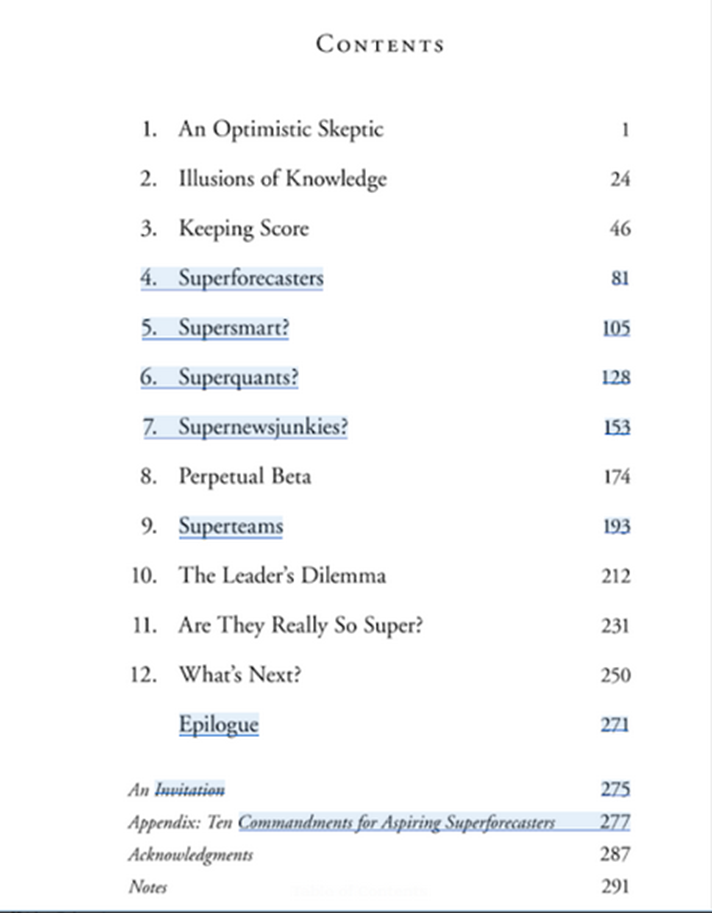
For example, the TOC for Superforecasting: The Art and Science of Prediction goes as such*:*

When I compare Tetlock’s TOC to my copy of Aristotle’s Politics… call me a clock — I am ticked about this TOC. Tetlock’s TOC is not useless, but it is a far cry from Adler’s ideal of a useful road map. In Tetlock’s defense, I’m sure this was an editorial decision—all popular science books are written this way now. Furthermore, while there were subheadings to each of Superforecasting’s chapters, they were not included in the TOC. I imagine this was not Tetlock’s fault. I don’t know, but my guess is that clean, minimal TOCs of exactly one page are publishers’ choice right now.

With this Table of Contents, I can tell you Chapter 1 is about Tetlock’s position. Chapter 2 is about uncertainty… no, wait, it’s about experts and his previous book Expert Political Judgement. Chapter 3 is how a scoring system works. You get the idea, but the problem with this, is that each of these chapters actually contains far more than I can quickly recall from seeing the chapter title. The subsections of each chapter would help immensely.

Benjamin Jowett’s TOC for Aristotle’s Politics stretches an immense eleven pages. Here’s the table of contents of just a part of Book 5. (For those who don’t know, in most editions of ancient works ‘Book’ is used in a way we might use Chapter, and chapters are just a few pages.)

BOOK V

Chapters 5—12. Revolutions in particular States, and how revolutions may be avoided.

5. (a) In Democracies revolutions may arise from a persecution of the rich; or when a demagogue becomes a general, or when politicians compete for the favor of the mob.

6. (b) In Oligarchies the people may rebel against oppression; ambitious oligarchs may conspire, or appeal to the people, or set up a tyrant. Oligarchies are seldom destroyed except by the feuds of their own members; unless they employ a mercenary captain who may become a tyrant.

7. (c) In Aristocracies and Polities the injustice of the ruling class may lead to revolution, but less often in Polities. Aristocracies may also be ruined by an underprivileged class, or an ambitious man of talent. Aristocracies tend to become Oligarchies. Also they are liable to gradual dissolution; which is true of Polities as well.

8. The best precautions against sedition are these: to avoid illegality and frauds upon the unprivileged; to maintain good feeling between rulers and ruled; to watch destructive agencies; to alter property qualifications from time to time; to let no individual or class become too powerful; not to let magistracies to be a source of gain; to beware of class-oppression.

Okay. Now this might be a bit excessive, but it is both useful before reading the work, and as a reference while in the weeds to see where the current section is going. A quick bird’s eye review of the table of contents gives the reader a context for understanding, for example, Aristotle describes Hiero of Syracuse use of secret police in Chapter 11. The TOC for 5.11 tells us that “Tyranny may rely on the traditional expedients of demoralizing and dividing its subjects” and here Hiero is an example one such tyrant, who kept his adversaries from coordinating by keeping them in fear. Astute readers easily see then how this example fits into the larger work of Book V, and even the larger vision of Politics.

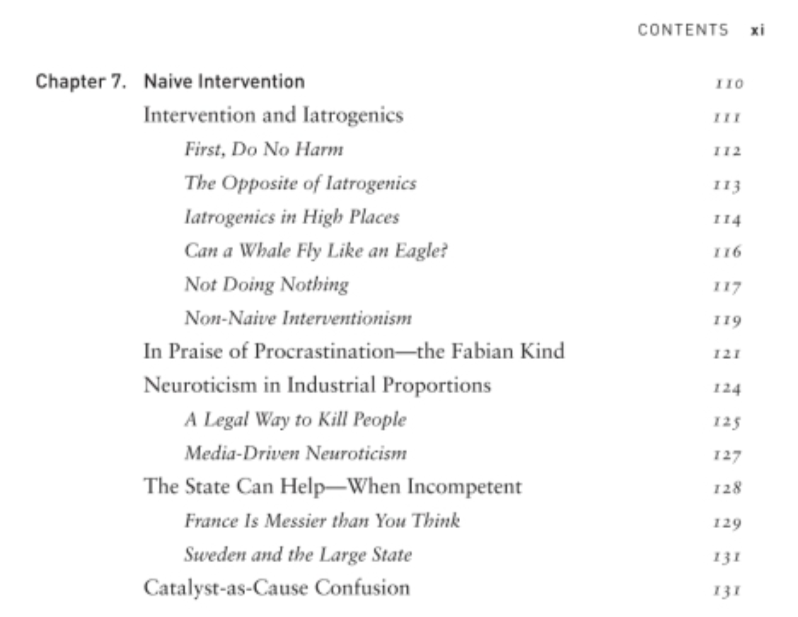
Besides terse chapter titles with no subheaders, another problem one runs across in TOCs are totally coy titles. As one friend told me, “Often, even after I’ve read a modern nonfiction book, I can’t recall what a given chapter is about from the table of contents because they all have titles like ‘The Mouse and the Octopus’ or ‘How to Play Cribbage in a Boiler Room’.” I didn’t ask, but I think he had Antifragile: Things That Gain From Disorder in mind:

I appreciate that Antifragile has all of its subheadings included in the TOC. Some of them are quite useful, and I remember some of the sections therein quite well. Why do I remember some of these sections quite well, but not others? I suspect that the common cause, besides the punchiness of the writing which sometimes sticks, is their descriptive quality. Some of these subheadings, however, I just have no idea about. What was “France is Messier Than You Think” about? I vaguely recall the phrase “protesting as a national sport”. (In fact, I only remember the protesting as national sport thing, because I went to look up the book or article he was referencing and couldn’t access it.) Despite a less than perfect score on the table of contents, Taleb has the redeeming quality of plainly stating the thesis of his book at the beginning and again at the end in two different formats–verbal and mathematical. That he does this clearly improves an otherwise droll book sevenfold. A clear thesis provides a framework to his soup of spiteful words, amusing descriptions, and insightful lessons.

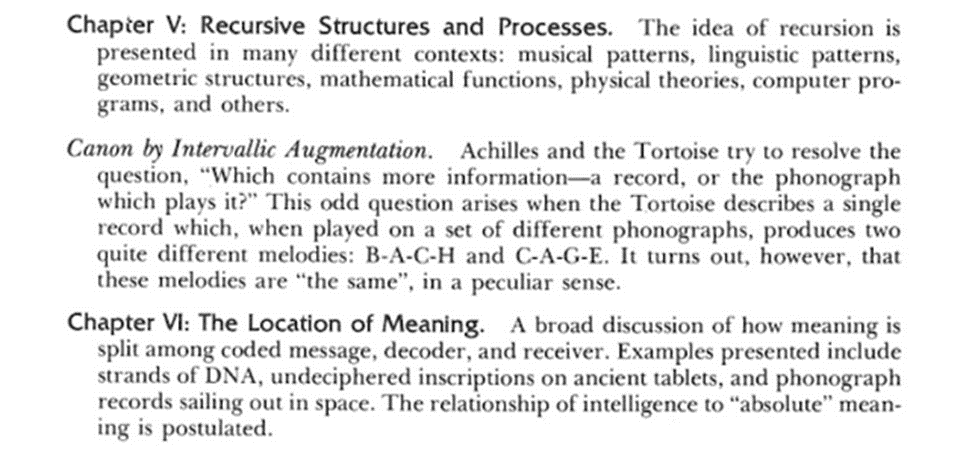
Douglas Hofstadter, known for his tyrannical control over each aspect in the production of his books, provides a very pleasant six page Overview immediately after the two page Table of Contents in Gödel, Escher, Bach: an Eternal Golden Braid. For those who have read it they will know, GEB is not really a book with a thesis, it’s an experimental work. The Overview, I think, makes that clear.

Take my word for it, though, most authors are not Douglas Hofstadter and will not try to maximize the information available to the reader for the purpose of the learning journey. So what can we do given the state of TOCs? Because most publishers prefer mystique, and the general public is willing to endure nearly useless Tables of Contents, one has an opportunity to engage with the book deeply and create your own Table of Contents at the beginning of the book on the blank page and in all that white space publisher left for you. Maybe something like this for Chapter 3 of Superforecasting:

3. Keeping Score

Ballmer’s Forecast on the iPhone – imprecise predictions can’t be assessed

a. “A Holocaust…Will Occur”

Predictions about Chernenko’s successor – hindsight bias rife among experts

b. Judging Judgments

Imprecise phrases like “very likely” and “serious possibility” – Sherman Kent’s Solution to numericize language – it was never adopted – The wrong-side-of-maybe fallacy – what calibration means — overconfidence and underconfidence – Brier Scores

c. Meaning of The Math

Brier Score Meaning depends on the Difficulty of Predictions

d. Expert Political Judgement

EPJ Program to assess expert predictions 5- 10 years out

e. And The Results…

Ideologues did worse – hedgehog and fox distinction – prototypical hedgehog Larry Kudlow and his recession denial – Foxes are more boring than hedgehogs

f. Dragonfly Eye

Sir Francis Galton and The Wisdom of Crowds – why crowds work – foxes simulate a crowd – Richard Thaler’s Guess the Number Game – using different perspectives yields more accurate guesses – Seeing poker through the perspective of the opponent – the dichotomy is a simplification, a mere model

Obviously, you can’t make a new table of contents off of the 20 minute fling we discussed earlier. You need to have read the work at least once. But if you do choose to make your own Table of Contents after you have read the book, then you are probably well on your way to a deep understanding of its material. But we are getting ahead of ourselves. We should talk about the first full reading of a work.

The First Full Read and Types of Notetaking

Through your first reading of a difficult text it makes sense to keep a brisk pace. Your goal should be to read all the parts you can understand *at your current level of knowledge.* Even though the work may be in your native language officially, if it is the type of work which is challenging you, then you need to read it as though it is a foreign language. Look for the key repeated terms and don’t worry if you do not understand something. Don’t slow down to work out the math section which is above your level, or to look up that arcane word which has something to do with naval batteries; read everything that is in the 75% comprehensible range and above. Slow down a bit when you have to, but avoid getting bogged down. This first reading, though still superficial, should provoke you to ask all the questions you need answered to make total sense of the text next time around. At this point you can go back and build your personal table of contents and then either embark on a closer, analytical reading to make sense of the work, or do whatever it is you need to do with the text.

Perhaps the most common way for a reader to take control of a text is through note-taking. The theory of note-taking, however, is a swamp of preferences and methods. Ideally each person uses a method which fits their context. What type of notes a reader takes should depend upon the reader’s expertise in the field AND on their purpose. This is why interactive learning platforms are so hard to create. Learners have disparate purposes and come in to a topic with different holes in their knowledge and understanding. For these same reasons, it is nonsense to say that there is a right or wrong way of taking notes in the abstract. Furthermore, some scream sacrilege about writing in books, others feel it is essential to making the book their own possession. Some prefer typing for its speed, others love baroque note-taking systems, like the Cornell method. Despite the diversity of methods and the idiosyncrasies of users, it is worth surveying five purposes of note taking and methods for going about it, so that readers can choose the method which suits their purpose best.

  1. Structural notes outline the sequence of topics covered by the work. This can be done in the margin or in a notebook. One can make a “key word outline” or key phrases. Seeing the structure should facilitate understanding the purpose of the arguments and descriptions.
  2. Substantial notes summarize the key arguments, descriptions, and examples in order. For this, one would want to identify important sentences or sections. Rewrite them, highlight them, or indicate them with a vertical line in the margin. The examples, descriptions, and specific arguments put flesh on the airy concepts and add meat to the otherwise bony structure.
  3. Conceptual notes paraphrase several takeaway ideas from the work in your own words. These are probably not written in the work itself but in a separate document.
  4. Critical notes include your emotional and intellectual responses to the key sections, core arguments, and general ideas of the work. This really should be done last. Of course, our temptation as intelligent readers is to prejudge based on what we already know. Understanding the author on his own terms is an essential goal. I have no fleshed out strategy for balancing the competing need to be both a discerning reader and a lenient judge (at least at first). More ideas welcome.
  5. Dialectical notes cross-reference passages from the work with similar or contradictory passages from other works you have read and even can cross reference previous ideas from the book in question. These notes are crucial when overviewing a broad topic and seeking to understand the shape of a wider conversation and not merely one author’s voice in it.

Note taking, I think, for most people is an annoying exercise. It requires much attention and effort and crucially takes longer than reading. Paradoxically, patience with note-taking takes time to develop, especially because it takes a long time to bear fruit. A decent rule of thumb is that the more invested a person is in mastery, the more time will be spent note-taking. While the conscientious may go overboard for fear of missing something, most need only assess to what extent they are reading for enjoyment, and then what type of notes to take becomes clear.

Marking enjoyable sentences, difficult passages, crucial arguments, and genuine insights is something one can do even when reading mostly for pleasure. Fun notes offer a sense of completion and something to show for your time.

How the Uses of Books Should Inform the Writing of Books

Books lend themselves well to use by people of all levels of expertise, from professionals to novices to dilettantes. A professional who is clued in to the larger conversation can mine through a book quickly and discover the interesting and unique insights, a novice can read slowly and digest each element of the work making notes and outlines and summaries, the dilettante can sample and read superficially, reading for pleasure sometimes and at others for a deep understanding. No group is slowed down by interspersed flashcards or interactive elements, which may be useful for some, but for others superfluous. As a medium, standard books offer significant optionality to readers, a freedom to choose when to slow down, speed up, when to stop to take notes, when to skip a section. These decisions can be be made quickly, easily, and sometimes even subconsciously. While audiobooks whisk listeners onwards for hours, books progress only at the rate of your processing. Studies on eye movement reveal the advantage of a medium which does not assume the manner in which a reader will engage with the information. Assuming we are not vetting readers for expertise, book design should offer accessibility to both professional and novice readers though they read differently. Experts navigate across the page differently and chunk information more efficiently. Despite these differences, a difficult book still should offer a gateway into a subject for the novice (learnability) and seamless navigation for the expert (discoverability).

I have formulated a few ideas explaining what publishers already do and what they should do to improve the medium further. Some of these ideas transfer to long form online articles as well, and if I put together a website this year I am now on the hook to practice what I preach, otherwise you have permission to harangue me with strongly worded emails.

Authorship 101 says that a book needs a definite and discoverable structure. We’ve already talked about this with tables of contents. However, it is important to remember as well, that reading even a detailed skeleton of a work is not the work itself. If a work is all skeleton, then there will be too much room for abstract misinterpretation or the evaporation of the ideas into meaningless platitudes; there needs to be some meat, specific arguments and examples and anecdotes. However, the ratio needs to be right. Too much meat and we rightly call it fat.

Books require cues which remind readers of their location within the conceptual territory of the work. The chapter titles and or section titles restated at the top of the page, page numbers in the bottom, or even paragraph numbers at the beginning of paragraphs (which make citing nonfiction way more convenient across platforms. This is one of the pleasant things about ancient classical works for example, Republic 514a always refers to the allegory of the cave paragraph in Plato.) these all serve to contextualize the page. Footnotes give the reader assurances while reading, and can help readers generate further inquiries quickly. Guns, Germs, and Steel: The Fate of Human Societies lacks footnotes and has such lackluster citations in the endnotes that I found myself growing more and more suspicious of the narratives as I read.

The Landmark History Series does everything in its power to make old historical works accessible to novice readers of classical history as well as experts. Here is the explanation of the method from the series editor, consider this whole block as though it were bold and italicized. It’s that worthy of emphasis:

Text features in Landmark editions are designed to assist the reader including side notes which are found on the outside page margin at the beginning of the chapters into which the ancient text was divided long ago by Alexandrian scholars. Normally, the first two lines of the side note display the book and chapter number and the date (if known or applicable). The third line shows the location of where the action takes place (or in some cases, a topical title). Finally, there is a summary description of the contents of the chapter. Each chapter contains section numbers in square brackets, such as [2] to mark the divisions into which scholars have traditionally divided the text for ease of search, analysis, and discussion. Running heads are placed on the top of each page of the book which at a glance provide date and place and a brief summary of the action of the first complete chapter on the page. Footnotes not only refer place-names in the text to nearby maps, as mentioned above, but they may serve to connect certain points in the text to other relevant sections, or to the work of other ancient writers and poets. They also cite particular paragraphs in the Introduction or in one or more of the appendices where the reader will find discussion of the topics or events footnoted. On occasion, they provide background information that does not appear in any of the appendices. They may also point out and briefly describe some of the major scholarly controversies over interpretation, translation, or corruption of the text. A few explanatory footnotes are quite long and detailed, but they contain important information which could not be further condensed. Footnotes and map data are repeated throughout the work to assist those who will read only selections from it, or whose reading of the text is discontinuous.

The result of this editorial care is a historical series which is deeply informative. Twenty minutes with any book in this series always lends itself to progress in understanding. And this should be our goal when putting together written works – to make our medium serve as many readers as possible.

Other innovations can and should be developed, especially for presenting long essays online. Gwern’s long essays are probably the best I have seen formatting wise. Wikipedia is acceptable. The New Yorker’s website does a poor job providing a sense of place to the reader. Audiobooks are necessarily abysmal (frequently Audible does not even include the subsections or chapter titles in their navigation pane). But when it comes to the physical book the Landmark Series is the best I know.

Realist history in one beautiful volume

A beautiful volume inviting the reader to master it.

Fool’s Gold: The Perfect Five Day School

Here’s my bet: hybrid schools will proliferate over the next 20 years.

The advantages of school are obvious: learning at school gives a social dimension for a social creature. Friendship, role models, and social expectations motivate learning. It’s a fact of nature that the formation of the rational soul requires society. There is no gene for phonics or temperament of trigonometry. Manners and milieu maketh the man.

And the basic unit of society is the family.

Tolstoy opens Anna Karenina with an immortal line about the special uniqueness of all families.

“All happy families are alike; all unhappy families are unhappy in their own way.”

But Tolstoy is exactly wrong. The more we conform ourselves to the Logos, the more individual and happier we become. We cease comparing ourselves to others and competing, and instead become the saint only we can be. The golden calf appeals to the mob, not the man alone on the mountain.

The hybrid model sits on the frontier of the trade-off between family & self-cultivation and peer interactions & peer-pressure.

What the hybrid model does for the high school student is provide structure, friendships, social expectations, and role models without creating an environment of conformity. Students have the space to self-pace and detach from the school peer group. They are free to grow in their uniqueness. By giving students multiple institutions to participate in, church, family, and school, the awesome power of social conformity dampens.

Let’s ask a different question. Are we moving towards a future where the best opportunities for learning are centralized in one building with lots of other people? What indications do we have of that? Very little.

Our milieu is the age of increasing decentralization.

Technology has transformed and will continue to transform the nature of society. It creates immense opportunities for the virtuous to grow in knowledge and capacity, and for the foolhardy to fall into fictions and fantasies. Decentralization of learning institutions will continue.

For us, this means that offering the best high school formation cannot all be school-based. The lion’s share of great souls and roaring saints will be deeply individual and inimitable. They will need their church, families, jobs, outside associates, in addition to school for true soulcraft to occur.

School as a learning factory, school as a holding cell, school as place where entire age cohorts are subjected to each other’s peer pressure for long periods day-in and day-out, even in the best circumstances, such as that of Catholic boarding school (my own experience) costs a high school student their family bond, the bond which the papacy and specifically the local bishop has commissioned us to bolster through this mission.

When the Jesuits started their education system in 1599, their schools met four days per week. Wednesday was the off day. Still in France around 80% of high schools are four-day. School is not education. Don’t let school stand in the way of education.

At JPII, we have two home days. Those two days to work on our education without school holding our hand. Those days ours to become our true selves within the context of our family and community. This is the cutting edge of the JPII Ministry.