Teemu anchors me now. He is a young jazz musician and composer who just finished his studies at the Helsinki conservatory. He just started taxi driving this week to pay his bills. He suggested immediately that we drop my stuff off and go swimming. His apartment is situated near the harbor. Like most apartment complexes there are a few benches and a firepit outside. The apartment has a kitchen and bathroom that are shared between the two electronically locked bedrooms. One room is his roommate’s whom he has not seen in a month or so. The other is his. He warned me that if I leave the bedroom and shut the door behind me without the key, there will be no way to get back in. Everything required the swipe key. If I didn’t keep it with me at all times, I could lock myself into a bad situation. But the accommodation was great. I had a desk.
His girlfriend Valpuri picked us up and we went to a remote beach outside of town. On our way in the car, her dad chanced to pull up next to us at an intersection. He was on a motorcycle, sported a short grey beard, and exchanged some quick words and a snorted laugh before speeding off. “My dad is like the bohemian of the family; and my mom is the academic. I’m surprised they are together,” Valpuri said. I enjoyed the thought of her mom’s mind finding respite in a bit of an eccentric, who collects instruments without playing them and sets them around the living room like art pieces against his wife’s wishes. Teemu bewailed that her dad never let anyone else talk in conversation. But his barley beer gut and story-telling persona I later found to be good companions in the sauna.
We relived childhood pool games, holding our breaths and skipping stones and such. The water was warm when in it, but out of it there is only one choice: dry off quickly. We drove back to the city and went to Sampo Muikkuravintola for traditional Savo food. I ate muikkut, which are little white fishes from the nearby lakes, served with potatoes, cucumber, tomatoes, and catsup. We sat and talked. I gave an introduction to Plato’s Apology. Teemu told about his musical work. Valpuri presented some interesting facts about the region and the local dialect. For example, in this region people add syllables instead of taking them away. That type of development adds character, flavor, and sometimes even meaning. The slang and faster style of Helsinki she finds monumentally boring.
Later we entered the forest, found some blueberries. At first there was brush and trees of different types. The air was fair and open as the trees turned to tall spruces. Then our path ran into a deep line of heavy pine trees. The density of the pine forest and smell was Grimm, but we came out upon one of the thousand, thousand wind shelters that pepper the forests of the northland. They overlook good spots, have a firepit, and sometimes split wood left by the previous people out of courtesy. We sat quietly.
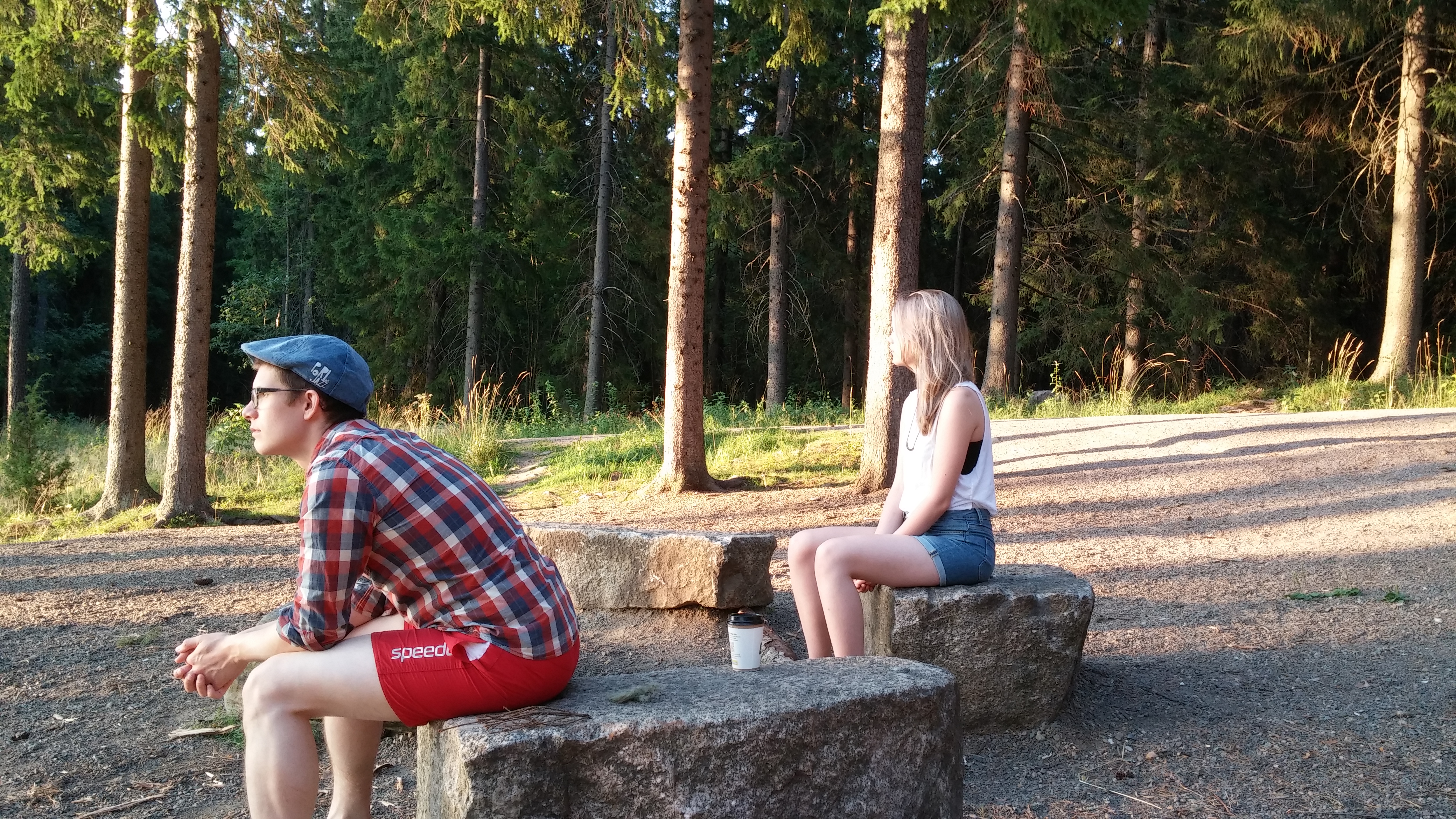
A day later when Teemu was out at work. Valpuri suggested that I become more sophisticated and learn about Finnish candy and chocolate. “You can tell a lot about a people by their candy.” I agreed on the condition that we give fun reviews to each piece. With candy and a coffee we sat out. I gave reviews, “This is one is like a young pony. Like licorice that wants to grow up to be caramel. This one was born an old lady – the Benjamin Button of candy. Here, a mint in metamorphosis.” The Karl Fazer Raspberry Yoghurt with Milk Chocolate reigned Lord of Tasty Town. Very rich, something to take one bite of every 15 minutes. I ate more candy, than I had in many years. I don’t know what I learned about Finland through candy. All my analogies involve age, so it follows that Finland is young and energetic, and has the fear of growing old, or becoming something hän (gender inclusive) is not, or not liking who hän is; namely, all the feelings of potential and anxiety that we feel when young, energetic, and slightly cynical are found in their candy. Or is it as simple as saying that licorice is popular?
The next day Teemu had to teach me about ice cream. He demanded, quite against my inclinations, that I try licorice ice cream. I expressed concern that no one on earth truly likes licorice. They like that it is a different flavor; they come to prefer it or crave it because of its uniqueness on the palette, but they deceive themselves to say they actually like it.
Aino Double Cream Licorice Ice Cream makes most other ice cream look like freezer burned sherbet. A type of soft licorice is blended into the thick fatty ice cream. It is really something else. It transcends all expectations and has altered my ice cream outlook permanently.
 Sebastian Garren