A Networked Identity May Be Better

[This letter is part of the Little Letter Republic, a project whose purpose is to build community in St. Louis. You can read Jared’s response here.]

Dear Jared,

Vogue ideas come in two types: the useful and wrong and the right but unproven. The idea of keeping one’s identity small is the former. Even a modest amount of questioning of the injunction to keep one’s identity small produces a much richer and more robust account of identity and how we should frame it to ourselves. You may start adulthood by pruning your identity, by all means, but to keep it small in perpetuity, I think, does violence to true flourishing.

‘Small id’ as I’ll call the concept begins from a good place. Two motivations led to Paul Graham’s ‘small id’ theory. The first, a desire to be able to think clearly about one’s own life without falling into cognitive traps, traps like motivated reasoning, taking only the inside view, or becoming immune to new information, and the second, a desire to stand outside the ceaseless cacophony of identity-based moralizing and prejudging, that is, to avoid the identity language which replaces explicit reasoning with a signal of group belonging. Both motivations aim towards making the world a kinder and more rational place.

The idea of the small identity attracts people who prefer propositions to group-based thinking – decouplers, Scott Alexander calls them, and for good reason. Identity words in language contain more connotation than denotation, and such a linguistic situation drives explicit reasoners mad. To identify as a rationalist, a philosopher, a Lord of the Rings fan, a Catholic, carries with it all sorts of unwanted associations, misapprehensions, and prejudgments from others. And to the explicit reasoner the only gain of identifying as something is belonging to a tribe at the cost of thinking clearly about any of those identities. But this is a false dichotomy and a confused formulation.

Around college, I stopped identifying as Catholic. When the topic of religion came up, I said instead, “I practice Catholicism,” which to me freed me from the notion of belief and the baggage of the -ism. At the time I rejected the existence of belief and identity! Furthermore, I did not want to be associated with a particular set of propositions, but instead with a particular set of actions. This was not a case of wishing to clear the space to think about the propositions more clearly. I simply didn’t want to use any identity-based terms in my vocabulary, but only to refer to actions themselves under the theory that action captured reality better than these nouns. But in truth, did anyone notice the language game I was playing? Nay, no. The absurdity here is obvious. If small identity were the right prescription, then why not reject all identity as I did? “I’m not your husband, honey, I just practice husbandry (and by the way I am great at it)!”

Rejecting all identity is impossible nonsense. But even aiming for smaller identities poorly applies to the goal of clearer thinking. A smaller identity does not free one from cognitive bias any more than a small kingdom is less worth defending to its inhabitants. A person might be more reasonable about a thousand things that have nothing to do with him, but still be infused with a blind and passionate zeal about the few remaining things. A balanced mind can illuminate all aspects of life without becoming far-sighted or near-sighted.

Julia Galef offers a different formulation to counteract the objection here, “Hold your identity lightly.” The phrasing here offers an elegant image of the soft touch. She has said that reducing one’s identity seems like it is asking too much, so she offers this seemingly more achievable advice. I think lightly held identity improves upon the small id concept, but still, we need clearer methods for achieving lightly held identity. To do so we need to define our key term.

Identity is used in many ways. Some people equate it with the thing one is tribal about, i.e. irrationally committed to. This relies upon reducing the entire concept of identity to one negative connotation “of caring too much.” In this view, having hills to die on at all is seen as suspicious. Julia Galef gives the example of programmers who overcommit themselves into some dogmatism about programming languages. I object that the problem of most nerdy people is not that their identities are too big, but rather that their identities are too small and thus they become a cartoon character, a two-dimensional caricature, focused upon trivialities because their identity has not expanded to contextualize their interests and loves. It is a little soul which doesn’t keep deeper thoughts and feelings in the background of their life.

Some people use identity to mean the whole person from the roles one occupies, to principled beliefs, to personal history. In this view identity simply means the explicit aspects of a person we can identify: Father, brother, husband, classicist, philosopher, teacher, rationalist, administrator, fan of LOTR, the Decemberists, Joel Coen movies, skier, rock climber, canoer, ex-traditionalist boarding school student, liberal, conservative, American, cosmopolitan, Catholic, nerd, and on and on forever. The problem with this maximalist view is that it totally ignores what motivates this conversation in the first place, which is that certain principles and loves, especially ones which are socially reinforced, are really dang difficult to examine well.

However, I think starting with the acknowledgment that identity is naturally large instead of the idea that identity is naturally irrational, gives us a better springboard for coming to hold ourselves lightly. As one reflects upon the multidimensionality of one’s own identity, I believe it becomes easier to scout out the geography of the self, to weigh the forces, to identify principal landmarks worth defending, and to choose better which hills to love dearly. Consider the self as a network. The more nodes and connections in the network, the less essential any single node is for the preservation of the network. In this model, self-examination is the process by which we knit together the nodes of self into a more coherent and better whole, while still maintaining a federated system.

Scrutiny of self causes less discomfort and criticism loses its sting when we can maneuver our mental forces among a variety of pathways. Sometimes a severe amendment of one node results in the loss of several others or whole branch gets pruned. I’d rather prune a great pine than a bonsai tree. I contend that a big identity adapts far better to the vicissitudes of life, is more open to critical inquiry, and can afford to change precisely because no single alteration to the ship of self undoes its entire identity, or in the case of the bonsai tree causes its death. Investigate your own nature to discover whether this frame works for you.

Thank you for entertaining my wandering thoughts on this little matter. In a very short time, I have grown a strong appreciation of your friendship and conversation.

Willing your good,

Questions on a Very Long Life

[This letter is part of the Little Letter Republic, a project whose purpose is to build community in St. Louis]

Dear Hamuel,

About 10 years ago my grandmother and I leaned on a balcony under moonlight in Florida. The black ocean licked sand so white that beneath the pale moon the sand glowed like an enormous, bioluminescent eel, a littoral Jörmungand waiting to be scratched by the bare toes of vacationers. My grandma said to me that summer night, “You know though I’m 68, in my heart I still feel like I’m 17.” When she was 17, she had her first kid, and thus that was the year of her adulthood. The implication was that the body ages but the soul still savors life, still loves youth and laughter, friends and song. If the eyes didn’t dim, and the mind didn’t go, and the knees didn’t ache, would we want to retire to eternal rest? Or would the sweetness inherent in life keep us here?

You and I discussed at length previously the passage in De Anima in which Aristotle posits that it is not vision which fails, and the soul does not grow old, and the intellect has the capacity to be eternal.

The case of mind is different; it seems to be an independent substance implanted within the soul and to be incapable of being destroyed. If it could be destroyed at all, it would be under the blunting influence of old age. What really happens in respect of mind in old age is, however, exactly parallel to what happens in the case of the sense organs; if the old man could recover the proper kind of eye, he would see just as well as the young man. The incapacity of old age is due to an affection not of the soul but of its vehicle, as occurs in drunkenness or disease. Thus it is that in old age the activity of mind or intellectual apprehension declines only through the decay of some other inward part; mind itself is impassible. – De Anima 1.4 408b

As per our previous conversation about the immortality of the soul, I have some follow up questions about long-livedness. Let’s imagine, as an intuition pump, that you will live out your body’s 40’s over the course of about 500 years, during your last 50 years of life you will age normally. (A small population of people also partaking in the thought experiment may also live this long, but not very many as we don’t have FDA approval for mass testing). Given a much longer life span what would change?

  1. Would you change your behavior in life? If so, how and why?
  2. Would the nature of the good life change? No? But the requirements you would need to procure a good life would change, right? And if the necessary accidents for securing a good life change, then in what sense are they accidents if they are necessary? There’s a bit of a puzzle here.
  3. Do you think human psychology can adapt to deal with such an extended lifespan? Why or why not?
  4. If you could adjust the number of years you will live in those long 40s to any round number what is farthest you would be willing to go?

As always, I cast the questions in the most misleading and equivocating manner I could. Avoid the traps and hooks and take the best bait you can without getting reeled in.

Good swimming,

Building a Little Letter Republic

[This is an experimental project in letter writing as a renewed art form. You can read CeltAtom’s reply here.]

Dear CeltAtom,

You wrote to me recently mentioning what a pity it was that your friend was pulled in to the “California rationalists.” The implication, of course, was that this was a misuse of his great intellectual talents. Whether or not it was a misuse, I think, is a question worth pursuing at some other time (as you know, I’m more optimistic). But if we consider the likely causes of an intellectual move into the Less Wrong crowd, I think we can discover important lessons for ourselves and our own goals of building community in St. Louis.

The Rationalists come together in digital and sometimes physical space to engage in discoveries, projects, and conversations. And while most of this activity takes place online, nonetheless, the majority of participants are curiously located in the same geographic area. The reclusive rightly guided caliph of the rationalist blogosphere Scott Alexander moved to the Bay from Michigan. Even he needs community. Tyler Cowen, who is intellectually adjacent to the rationalsphere, mentioned that his Emergent Ventures applicants are dominantly from the “usual places” especially the Bay, even though there is no geographic barrier to entry. I think the lesson is that geography matters for community — even open, digital intellectual community.

Your puritanical commitment on the geographically local perplexed me for years. Yet considering that you coined the term “California rationalists” and I knew exactly what you meant speaks louder than my manifold protestations that community can easily be geographically agnostic — the word ‘easily’ was greatly mistaken. Yes, you are correct. I see that if we are to build ourselves an intellectual home it will be local. It must be here.

On the other hand, what good is a community that can’t attract people like your friend? Would I want to be part of a community which can’t be discovered and joined by great people, people filled with potential, who will keep me sharp and help draw out of me a better version of myself? This is another lesson. People leave their native lands for Oakland, not for Oakland, but for the community they discovered and engaged with digitally. They received some benefit from its open output, and now they will make a home there physically. I think the lesson is clear: agglomeration is key to community.

A paraphrase of Marshall’s economics text makes the point.

When a [community] has thus chosen a locality for itself, it is likely to stay there long: so great are the advantages which people following the same [mode of existence] get from near neighbourhood to one another. The mysteries of the trade become no mysteries; but are as it were in the air, and children learn many of them unconsciously. Good work is rightly appreciated, inventions and improvements in [community], in processes and the general organization of the [institutions] have their merits promptly discussed: if one man starts a new idea, it is taken up by others and combined with suggestions of their own; and thus it becomes the source of further new ideas. And presently subsidiary [groups] grow up in the neighbourhood, supplying it with implements and materials, organizing its traffic, and in many ways conducing to the economy of its material.

Alfred Marshall, Principles of Economics, 1890 – bracketed terms are mine

What the Bay Area has done is created an agglomeration of different types of rationalists and rationalist adjacent people through precisely these effects.

When you read the works of Seneca, Cicero and St. Augustine, you might notice that much of their work is actually in the form of long discursive letters. These letters, like Seneca’s on friendship were both public and private. On the private side they were motivated by the conversation with a particular person; they are addressed to that person; and they are written to persuade that person. On the public side, the author expected the letter to be shared, shown, distributed, copied, and forwarded to anyone who could benefit from its contents. This is why we still have these letters today.

Similarly, the Enlightenment era Republic of Letters allowed people from the salons and clubs of Europe to stay in touch, receive encouragement, hear of latest discoveries, and, importantly, extend its reach to promising new members. Most of the American Founders were were part of a community of letters: Benjamin Franklin had David Hume, Richard Price, Joseph Priestley and Condorcet internationally, but locally he had his Junto, which was probably important for development in Philadelphia in many not-so-obvious ways. Letters and local community however were separate affairs in that era. Nonetheless, Franklin brought the value of an international community to his local community by founding a library which housed the latest volumes. He tried to build the culture he wanted to see in the world.

These Antique and Enlightenment era letters also revealed a certain code of conduct, a morality of the scholar, which was built upon a level of courtesy, (the Newton and Leibniz episode excepted), scholarly integrity, and open-handedness combined with rigor and a critical eye.

I submit that if we are to build community in St. Louis, its existence should be discoverable online, but its activity and direction should be local. If we are good, we will attract new good people – like your friend – to us. Nonetheless, our focus should be geographically constrained, because the thing to build and improve is a community here.

You, CeltAtom, are my primary audience. But if others can benefit from this communication, I want them to.

Cheerfully yours,

At Wendy’s Near an Interstate

He sits slumped over with a Where’s Waldo scarf

Slowly sucking down salty Wendy’s fries.

Slowly drooping over like an overladen branch

Slowly shutting down his eyes like a sun eclipsed.

His limp wrist dangles his five purple thumbs

Suspended by an elbow planted firmly on the table.

By that planted elbow a notepad sits with some ink.

The booth is overflowing with his girth, with his mass. 

“Is he breathing?” question the people as they pass.

I return to that notepad, which somber makes me think

A suicide note, or manifesto of a dream gone down the sink,

Or it could be a wish that’s at last been fulfilled.

Is that body breathing? Has he been killed?

His alarm beeps every five, for some meds or is it work?

He doesn’t stir or answer, but his fingers twitch and jerk.

It could be diabetes, a seizure, or a stroke.

Perhaps Lazarus is sleeping, the normal weary folk.

I creep to observe, as the alarm goes off again.

And sure enough he’s breathing, his life goes on and then,

My thought return to that notepad. Alack! What does it say?

Perhaps he’s dying very slowly, and the notepad points the way

To save him from this process of very slow decay.

Closer yet I get and entitled on the page.

3/15/21 it reads, a journal entry of a sage!

Do I dare read on, this man’s soul which laid bare?

I dare not, I dare not, for fear of what lies there.

I get my Wendy’s order. And awake the sleeping man.

“We thought it was a heart attack.”

He wakes, “Long week. Pretty sucky.

“No, not a heart attack – I’m not that lucky.”

Science and Technology Read 2020

The Devil’s Doctor by Philip BallTerribly meandering book. Had very little to do with Paracelsus, mostly because the author realized that Paracelsus is an incomprehensible charlatan. However, The book offers a very pleasant overview of 16th century flavor. And has good references to more interesting vistas, namely De Re Mettalica.
De Re Metallica by Georg AgricolaA thorough and systematic treatment of metals from finding the ore, to setting up the company, to digging, refining, and crafting. I wish more books were like this! This is a true science and engineering text. Perhaps the first truly comprehensive one in history. The Hoovers were wise to translate this and promote its place in the history of science.
Every Tool’s A Hammer by Adam SavageInspirational anecdotes about creating things.
Moonwalking with Einstein by Joshua FoerJournalist adventures into the art of memorizing. This volume while filled with stories, had just enough information for the reader to figure out how to start crafting memory palaces, and begin their own adventures in memorization.
Speed Reading in a Week by Tina KonstantI wanted to investigate the speed reading literature because even a modest improvement in my reading speed could mean an extra book or two read per year.
Evelyn Wood Speed ReadingBut it turns out that speed reading only kind of exists as a learnable skill. Most of the techniques are actually just extensions of the methods for reading well found in How to Read a Book, which is a far better use of one’s time.
Nuclear 2.0: Why A Green Future Needs Nuclear Power, Mark LynasMark Lynas is environmental activist who advocates nuclear and GMO proponent. In the book he talks about the anti-nuclear myths held by a lot of green activists which are holding back the fight against climate change.
I didn’t know about these myths, but somehow I had come to believe some of them, especially the idea that nuclear waste is a BIG PROBLEM holding back scaling up nuclear power production. Turns out it’s not.

People are the under the impression that if a reactor goes bad or is hit by an earthquake it will explode killing hundreds of people and damaging the environment for centuries. But a Japanese Nuclear Plant close to the epicenter of the 2011 earthquake took no damage, and while Fukushima melted down, 1 person died and there was some environmental contamination.

But other sources of power contaminate the lungs of workers, spill in the oceans, and spread CO2 in the atmosphere (or as the other alternate fuels are – inefficient and are NIMBY’d to death). To the bigger political point though, nuclear energy summons great fears in the minds of people; the grassroot support isn’t there.
Wiring CompleteVery helpful guide in how to wire things around the house! Highly Recommended!

Philosophy and Economics Read 2020

De Anima Commentaries by Themistius, Avicenna, Therese Corey, Averroes. Reading De Anima and the history of commentaries upon is like watching the same movie as imagined by many different directors. This philosophical tradition is so thorough in its discussion of questions that anything short of this method feels inadequate.
Stubborn Attachments by Tyler Cowen. He’s not Aristotle, but he offers a fresh take on what it means to be a worldly philosopher, in other words, a philosopher interested in the good of the world. Although I still have no idea what the title of this book means, I can tell you that content concerns a eloquent apologia for making sustainable economic growth as moral concern, something we should care about. I would be sold but moral concerns and logical arguments only work on honest and virtuous people.
The Moral Foundation of Economic Behavior by David C. Rose considers the basic decalogue that must be secured in order for there to be economic behavior. Inspired by his rule-based vision of moral foundations, I wrote a little list of seven rules that match it with the principles of Catholic social teaching.
Painting and Reality by Etienne Gilson. You can’t recreate the Sistine Chapel without the Michelangelo’s dyes! Beautiful reflection on the unique aesthetic qualities of painting.
De Rhetorica by Aristotle plus a few commentaries by Adam Smith. How is that one mind can speak so well on so many topics? In this blockbuster Aristotle instructs the eager philosophical public on how to bend the mind and emotions towards truth through the power of language. Adam Smith offered a pleasant insight in his Belles Lettres lectures when he cautioned that when the audience is positively disposed be like Aristotle, when they are negatively disposed be Socratic in one’s speech.
Age of the Infovore by Tyler Cowen. This was pleasant dose of encouragement on how to survive in the age of information and noise and to be more accommodating to people who differ from me. The book is really a call for magnanimity. But most importantly it pointed me in the direction of Das Glasperlenspiel.
Bowling Alone by Robert Putnam. The book on social capital, but do I even recommend it? It was solid, but soulless.
Big Business A Love Letter to an American Antihero by Tyler Cowen. While the author sees this book as a failed project, I came away with some important data and hard to rebut counterarguments to some common cultural assumptions about how business works. Some arguments I thought were quite weak or unappealing (I would prefer if businesses unrelated to culture did not become the arbiters of culture and orthodoxy…), but the chapters on CEO pay, inequality, and big tech made up for the small weaknesses. To me it was a huge success. Recommended.
Creative Destruction: Globalization and the World’s Cultures by Tyler Cowen. Look on the sunny side of globalized culture… there are Swedish musicians who specialize in Americana and Blues Rock, and Turkish musicians who make rap. But it cuts the other way too. I get to listen to Turkish folk music and Finnish pop and All of Bach! Demand for all genres is actually up, and musicians can access a global audience.
The Decadent Society: How We Became Victims of Our Own Success by Ross Douthat. A rhapsody on American culture. I like Ross’ writing.
A Time to Build by Yuval Levin. A fairly light read, it is more of a sermon than a serious treatise. The thesis of the book is that institutions are supposed to form each of us into a particular type of person. They ought not be mere platforms for self-glorification and expression. The goal of an institution is to coordinate people around certain ideals and mission, not merely to apply intelligence and efficiency to solving problems, but to apply character and integrity in the fulfillment of obligations and responsibilities. (It’s some timely moralizing, I’d say!) Here is a nice quote from the book:
“Many Americans are not lucky enough to have the benefit of a flourishing family, or the opportunity for rewarding work, or an uplifting education, or a thriving community, or a humbling faith, let alone all of these at once. But some combination of these soul-forming institutions is within the reach of most, and the work of reinforcing them, sustaining the space for them, and putting them within the reach of as many of our fellow citizens as possible is among our highest and most pressing civic callings. All of these institutions now need us, and we can help by taking them seriously.”
Russian Conservatism by Paul Robinson. “There are more types of Russian Conservatism, Horatio, than are dreamt of in your philosophy.”

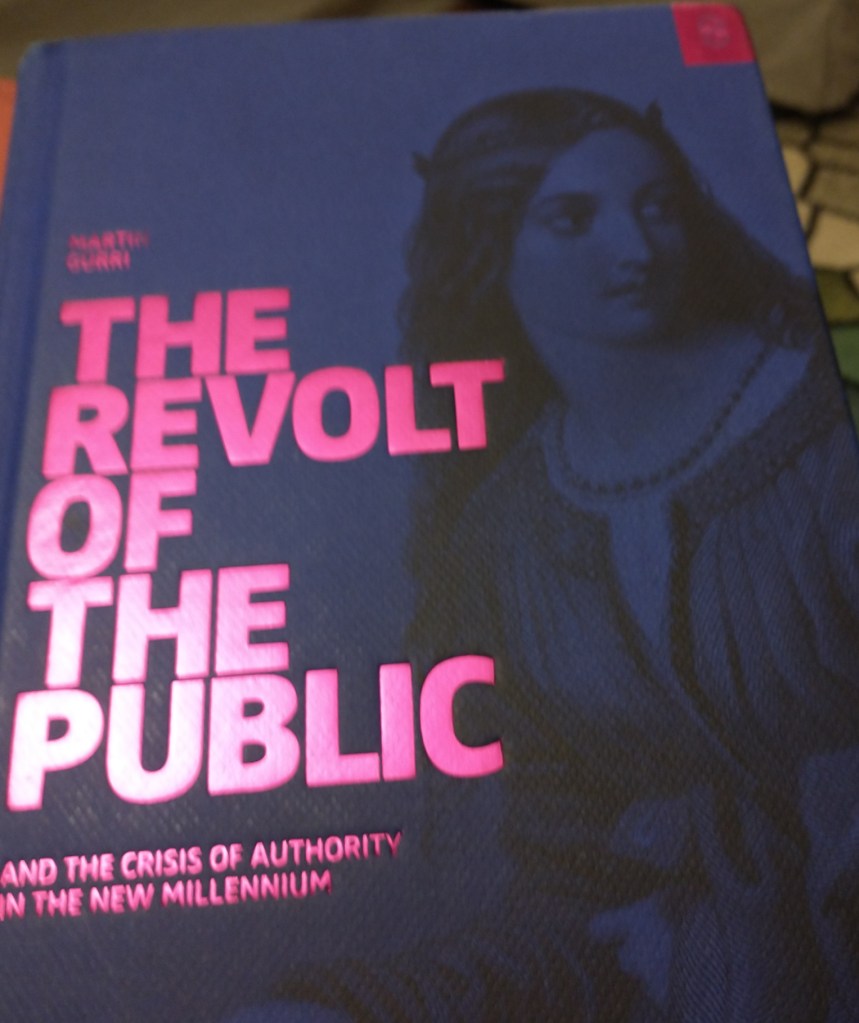
The Revolt of the Public

Ex-CIA digital media analyst, Martin Gurri, explored the politics of negation in 2014 and updated his thesis in 2018 in The Revolt of the Public.

The Revolt comes in pink.

The major thesis is that while the public becomes more highly networked and integrated with each other, elites have remained about as removed as they were pre-internet. This high visibility highlights their many failures, creates widespread distrust in their authority, and enables various revolts against the status quo in the form of (usually unreasonable) demands. The typical elite response is bewilderment and indignation. The savvy elite response is joining the public in blaming the leaders, the bureaucracy, or whatever malevolent force it is, and denouncing the system they are apart of.

Chesterton’s quip about love gains new meaning when the concept of neighbor becomes everyone we encounter on and because of the internet. “The Bible tells us to love our neighbors, and also to love our enemies; probably because they are generally the same people,” (Illustrated London News, July 16, 1910). This is why Christians are known for their calm and loving presence in the midst of Facebook flame wars…

The key, I believe, to getting the most out of this book, is to avoid thinking about the book in terms of our own favored political armies, and instead to focus on our personal self-adaptation. A noisier world is upon us. Living well within it is the challenge. The movements of today flash out like solar flares. Suddenly a mass of people can turn against an election, or a particular company, a particular minority, a city government, a court, a religion or a statue, a sector of the economy, or a nation. Indeed, anyone can be a besieger and anyone can be besieged by a suddenly formed public. And since criticism is cheap and available, we tend to engage in it too and judge ourselves vigilant and intelligent for seeing all the wrong.

Chesterton’s response is that “what embitters the world is not excess of criticism, but an absence of self-criticism,” (“On Bright Old Things and Other Things,” Sidelights on New London and Newer New York). For if we fail to see our own failures, we will fail to forgive others their own. Martin Gurri’s response adds a little more detail than this. Building trust across a nation built on traditional brick-and-mortar hierarchies requires humility, integrity, and openness. He spells this out as the only way forward for systems to appear legitimate in a highly connected world.

I am concerned with how to build trust in an age of distrust. How to build well and offer a positive vision despite all noise, much of it vile. Martin Gurri’s book lays out a solid analysis of one level of the forces at work, but there are many others. Ideology, economy, laws and culture still matter. However all of these are influenced by the lightning fast information age.

Fortunately integrity in the internet age is about the same as integrity has always been, we just have to use the new tools to fulfill it. At the personal level: never lie, explain your reasons for what you’re doing/believing, be open about the good you wish to do, be open for input, strive for virtue, take responsibility for your actions. In your organizations, serve your clients and colleagues, take responsibility for their good, encourage them to also strive for virtue, be open for input, create goals (and be led by them!), and never lie.

Religious Works Read 2020

Populorum Progressio by Paul VI
Sollicitudo Rei Socialis by John Paul II
Instruction on Christian Freedom and Liberation by Joseph Ratzsinger
Witness to Hope by George Wiegel
Gaudium et Spes by Paul VI
Gravity and Grace by Simone Weil
Code of Canon Law 1983 Vatican, Pope John Paul II
Saint Louis Jacques LeGoff
Fratelli Tutti by Pope Francis
Pastoral Care by Pope Gregory the Great
Rule of St. Benedict by St. Benedict

Fiction Read 2020

Milton by William Blake. Wild bright eyed prophetic mythopoesis by the great seer of the Romantic era. Illustrations by the author are grand and delightful.
The Three Body Problem by Cixin Liu. With the first chapter featuring the persecution of a physicist during the Cultural Revolution in China, we have the set up of a solid novel. Coming from the perspective of an author whose country has come from killing scientists to enthroning them within a generation, optimism and belief in the possibility of progress pervades the story. This novel can stand alone without reading the next two books! Thus it’s not a huge commitment.
There Once Was A Mother who Loved Her Children Until They Moved Back in by Ludmilla Petruvaskaya. From a Russian translation, comes three stories about the depressing psychology of desperate people. My wife and I read this in the hospital after childbirth. Our child has moved in, may he not move back in!
The Dark Forest by Cixin Liu. The megalopsychoi war against decadence.
Death’s End by Cixin Liu. What is progress? We begin with environmental degradation on earth and end with environmental degradation of the universe. “Make time for civilization, because civilization doesn’t make time.” A wonderful meditation on the relationship between progress and civilization. In our novel, the quest for unyielding progress can diminish civilization. But civilization without progress leads to decadence. Ultimately only self-gift can save us.
The Glass Bead Game by Hermann Hesse. Inspiring philosophical novel blending music and philosophy into a rarefied community. Since I am a total sap for intellectual coming of age stories and this one is framed in the ironic mode of a well-researched biography, from the onset the philosophical musings of the book pulled me. The dialogue form did not survive Plato, instead it was elevated into the philosophical novel. Here is a philosophical novel without reservation. The book also features some wonderful poetry, translated from German, such as “After Dipping into the Summa Contra Gentiles.” This was the best novel I read this year.
The Man in the High Castle by Phil K. Dick. Unsettling escher-like look at the reality of history. Ultimately, however, I found the most interesting part of the book to be PKD’s notion of economics. He presents a world in which Nazi economics is doomed to inefficiency caused by centralization but stands superior to Japanese traditionalism. He also thinks New Deal economics would have worked well, or does he? That’s the question.
The Parable of the Sower by Octavia Butler. Want to be punched in the gut by depressing and potent visions of a failing America? This is your book, though it’s ultimate message is hopeful. I enjoyed it, but really stopped feeling strong emotions after the first half of the book, when circumstances improved. I am undecided on whether I will continue to the next book, Parable of the Talents. Though, I do love a good parable.